Question: You should first complete assignment 22 A1 AA before completing this discussion post. First, re-read Problem Case #8 on pg. 669 in the e-book. This
You should first complete assignment 22 A1 AA before completing this discussion post.
First, re-read Problem Case #8 on pg. 669 in the e-book. This Problem Case is the basis of assignment 22 A1 AA. In this assignment you were asked to give your legal opinion.
Next read "Ethics in Action" on pg. 666 in the e-book.
In assignment 22 A1 AA, you were asked to give your legal opinion based on the legal rules and concepts from Chapter 22. Now, after reading the Ethics in Action paragraph, I want you to give your personal/ethical opinion.
Answer the following questions based on the scenario in Problem Case #8:
1. How would you assess the ethicality of the representations made by the salesperson in response to Barr's questions about the reason for the reduction in the price of the yacht?
2. In a case like this, should it be the responsibiity of the buyer to ask the "right" questions in order to protect themself?
3. Should there be an ethical obligation on the seller to voluntarily disclose material facts that may be relevant to the buyer in making an informed decision?
Write your answers using full sentences using proper sentence stucture, grammar, spelling and punctuation. HINT: You may want to write your answer in a Word document and use the Review/Editor tool to check your work, and then cut and paste your work into the discussion forum. Then post your answers in the discussion post.
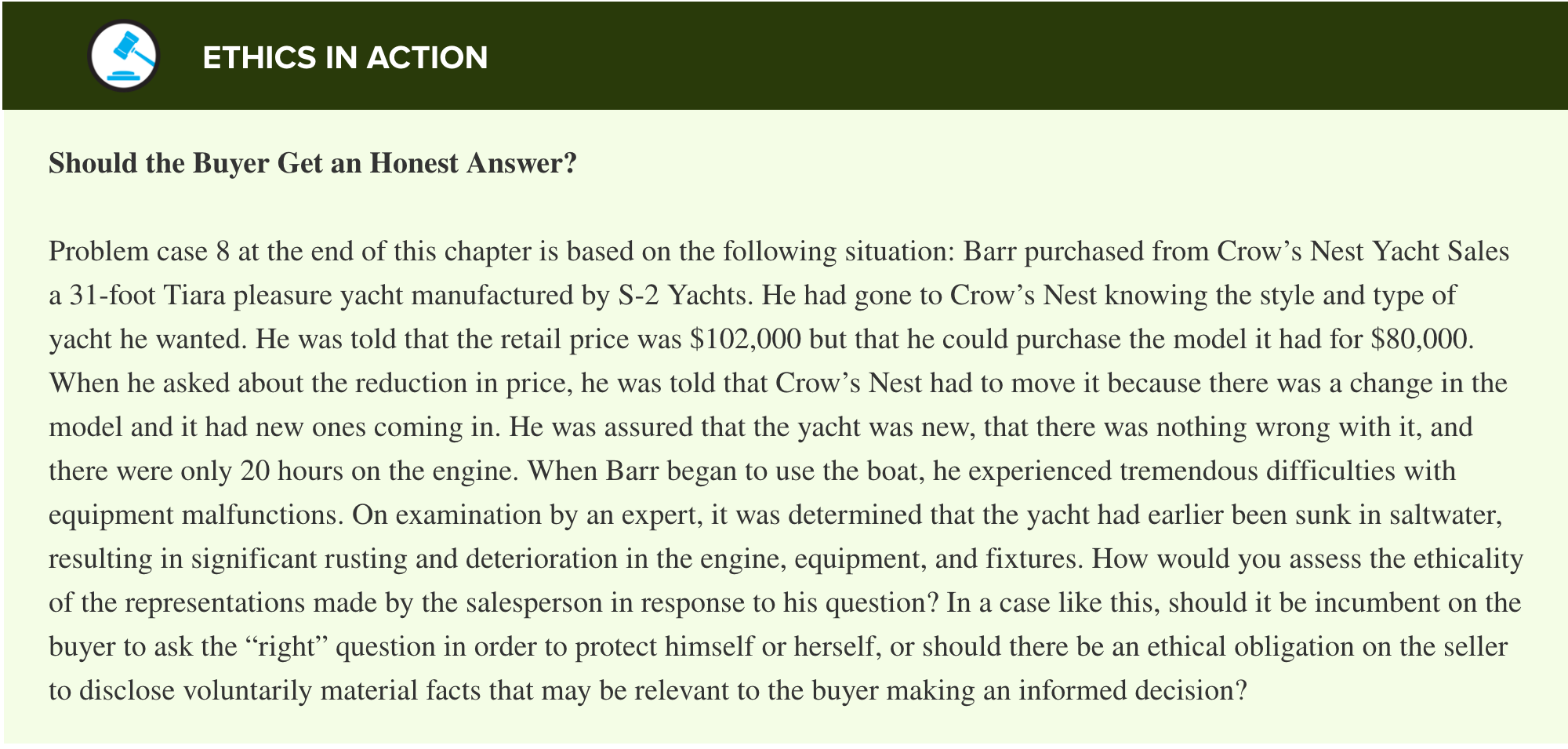
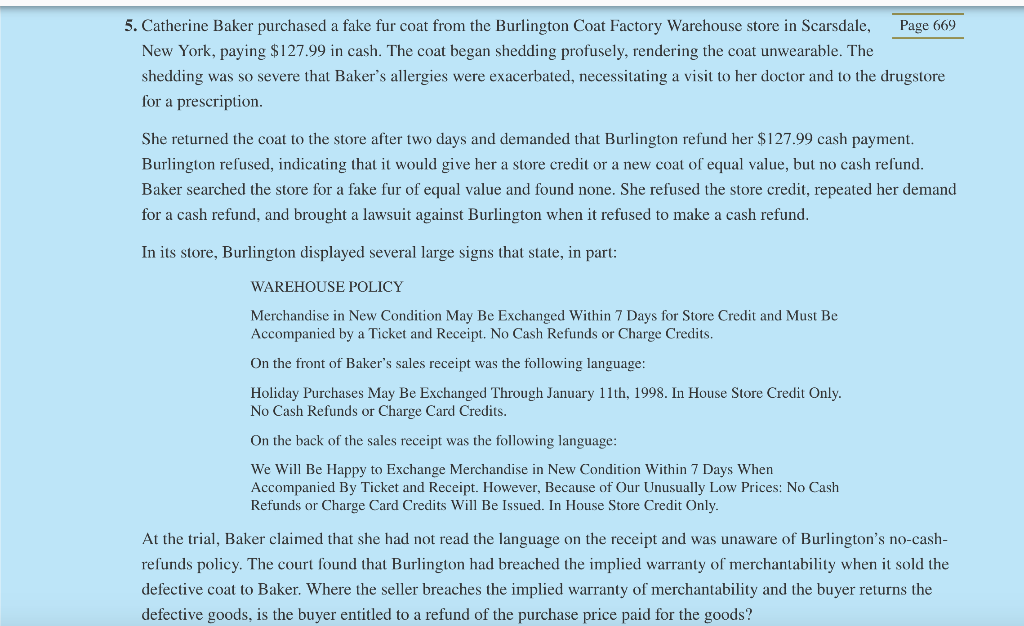
ETHICS IN ACTION Should the Buyer Get an Honest Answer? Problem case 8 at the end of this chapter is based on the following situation: Barr purchased from Crow's Nest Yacht Sales a 31-foot Tiara pleasure yacht manufactured by S-2 Yachts. He had gone to Crow's Nest knowing the style and type of yacht he wanted. He was told that the retail price was $102,000 but that he could purchase the model it had for $80,000. When he asked about the reduction in price, he was told that Crow's Nest had to move it because there was a change in the model and it had new ones coming in. He was assured that the yacht was new, that there was nothing wrong with it, and there were only 20 hours on the engine. When Barr began to use the boat, he experienced tremendous difficulties with equipment malfunctions. On examination by an expert, it was determined that the yacht had earlier been sunk in saltwater, resulting in significant rusting and deterioration in the engine, equipment, and fixtures. How would you assess the ethicality of the representations made by the salesperson in response to his question? In a case like this, should it be incumbent on the buyer to ask the right" question in order to protect himself or herself, or should there be an ethical obligation on the seller to disclose voluntarily material facts that may be relevant to the buyer making an informed decision? Page 669 5. Catherine Baker purchased a fake fur coat from the Burlington Coat Factory Warehouse store in Scarsdale, New York, paying $127.99 in cash. The coat began shedding profusely, rendering the coat unwearable. The shedding was so severe that Baker's allergies were exacerbated, necessitating a visit to her doctor and to the drugstore for a prescription. She returned the coat to the store after two days and demanded that Burlington refund her $127.99 cash payment. Burlington refused, indicating that it would give her a store credit or a new coat of equal value, but no cash refund. Baker searched the store for a fake fur of equal value and found none. She refused the store credit, repeated her demand for a cash refund, and brought a lawsuit against Burlington when it refused to make a cash refund. In its store, Burlington displayed several large signs that state, in part: WAREHOUSE POLICY Merchandise in New Condition May Be Exchanged Within 7 Days for Store Credit and Must Be Accompanied by a Ticket and Receipt. No Cash Refunds or Charge Credits. On the front of Baker's sales receipt was the following language: Holiday Purchases May Be Exchanged Through January 11th, 1998. In House Store Credit Only. No Cash Refunds or Charge Card Credits. On the back of the sales receipt was the following language: We Will Be Happy to Exchange Merchandise in New Condition Within 7 Days When Accompanied By Ticket and Receipt. However, Because of Our Unusually Low Prices: No Cash Refunds or Charge Card Credits Will Be Issued. In House Store Credit Only. At the trial, Baker claimed that she had not read the language on the receipt and was unaware of Burlington's no-cash- refunds policy. The court found that Burlington had breached the implied warranty of merchantability when it sold the defective coat to Baker. Where the seller breaches the implied warranty of merchantability and the buyer returns the defective goods, is the buyer entitled to a refund of the purchase price paid for the goods









 Study Help