



Question: You will be experimenting with concepts in Rotation Motion and Energy. These concepts include finding moment of inertia and verifying energy conservation . After conducting
You will be experimenting with concepts in Rotation Motion and Energy. These concepts include finding moment of inertia and verifying energy conservation .
After conducting this lab, you should:
- Be able to conceptually understand Moment of Inertia and its significance in Rotational Motion
- Be able to conceptually understand and verify Energy conservation
Experiment I : Find Momentum of inertia
Part a.) Set your inclined platform to 3 degrees. After measuring the length of the inclined platform, release the metal ball down the inclined platform, starting it at the top. and record the time it took to reach the bottom of the incline. Repeat the above steps 3 times. Repeat above steps but for a plastic cylinder, brass cylinder, aluminum cylinder and tennis ball.
Part b.) Set your inclined platform to 7 degrees and repeat above steps but for one trial each
Experiment II: Potential-Kinetic Energy Conversion
Part a.) Set your inclined platform to 5 degrees. After measuring the length of the inclined platform and the height of the table, release the metal ball down the inclined platform, starting it at the top. Before releasing metal ball, make sure edge of inclined plane is 5 cm from the edge of the table. Record the time it takes the metal ball to reach the bottom of the incline and the time the ball takes to reach the floor from the edge of the table separately. Measure the horizontal distance travelled from the edge of the table. Repeat for 3 trials.
Part b.) Repeat above steps but for the plastic cylinder, brass cylinder, aluminum cylinder and tennis ball
Discussion Questions
- Report all the data collected from experiment I part a. Find the average time each object took to reach the bottom of the incline. Which object took the least time to reach the bottom of the incline. Will any of the objects reach the bottom of the incline at the same time?
- Find the average acceleration and average moment of inertia coefficient for each object in experiment I part a. Compare the expected acceleration and moment of inertia coefficient with the experimental values by finding the percent difference between each. Do any of the objects have the same acceleration or moment of inertia?
- For experiment I part b report all data collected. How does the time down the incline and acceleration change for each object.
- For experiment II part a and b, find the average horizontal distance traveled by each mass from each set of trials. Calculate and compare the expected experimental distance traveled by each mass from the set of trials. Compare the expected horizontal distance traveled to the experimental horizontal distance traveled by finding percent difference
plz help me with this lab- physics 114 rotational motion lab- TCC
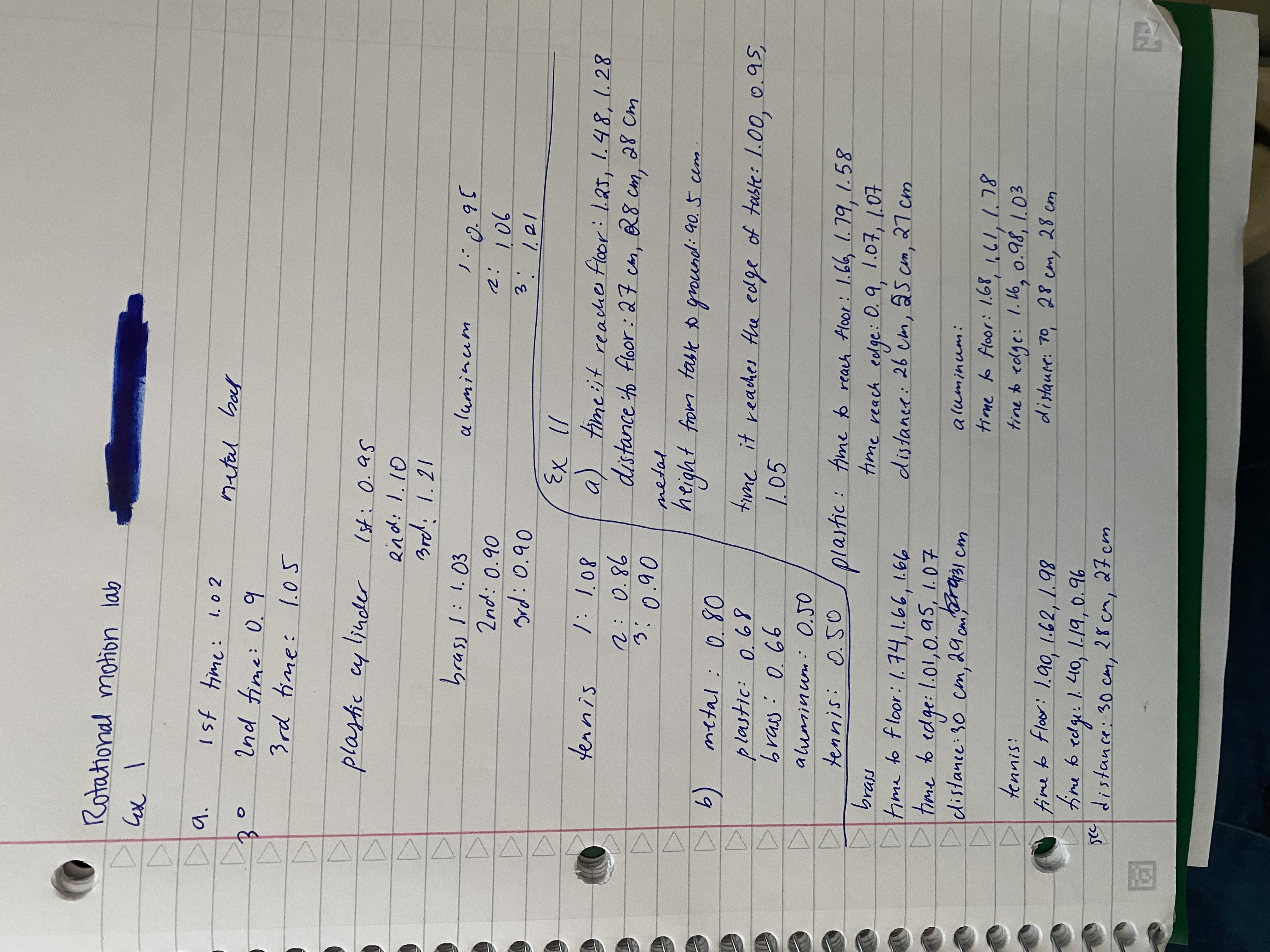
Rotational motion lab a . 1 5f time : 1. 02 metal bar B and time : 0. 9 3 rd time: 1.05 plastic cy linder Ist: 0. as and : 1. 10 3 rd , 1. 21 brass 1: 1. 03 aluminum 1: .95 2 nd : 0.90 2 : 106 Brd : 0.90 3 1. 21 EX 1 1 tennis 1 : 1.08 a ) time :it reaches floor : 1 .25 , 1 .48 , 1 .28 2: 0.86 distance to floor : 27 cm , 028 cm , 28 CM 3: 0. 90 metal height from task to ground : 90 . 5 cens D b ) metal : 0. 80 plastic: 0. 68 time it reaches the edge of taste : 1.00 , 0.95, brass: 0. 66 1.05 aluminum : 0.50 VIV tennis : 0.50 plastic : time to reach floor : 1.66 , 1. 79, 1.58 brass time reach edge : 0 . 9 , 1 .07 , 1.07 time to floor : 1. 74, 1. 66 , 1.66 distance : 26 cm, 25 cm, 27 cm time to edge : 1. 01 , 0. 95 , 1.07 distance : 30 cm , 29 cm ? rail cm aluminum : time to Floor : 1. 68, 1, 61, 1.78 tennis : time to edge : 1. 16, 0.98, 1.03 time to floor : 1 . 90 , 1 . 62 , 1.98 distance : 70, 28 cm, 28 cm time to edge : 1. 40 , 1.19 , 0.96 See distance : 30 cm , 28 cm , 27 cm
Step by Step Solution
There are 3 Steps involved in it

Get step-by-step solutions from verified subject matter experts