







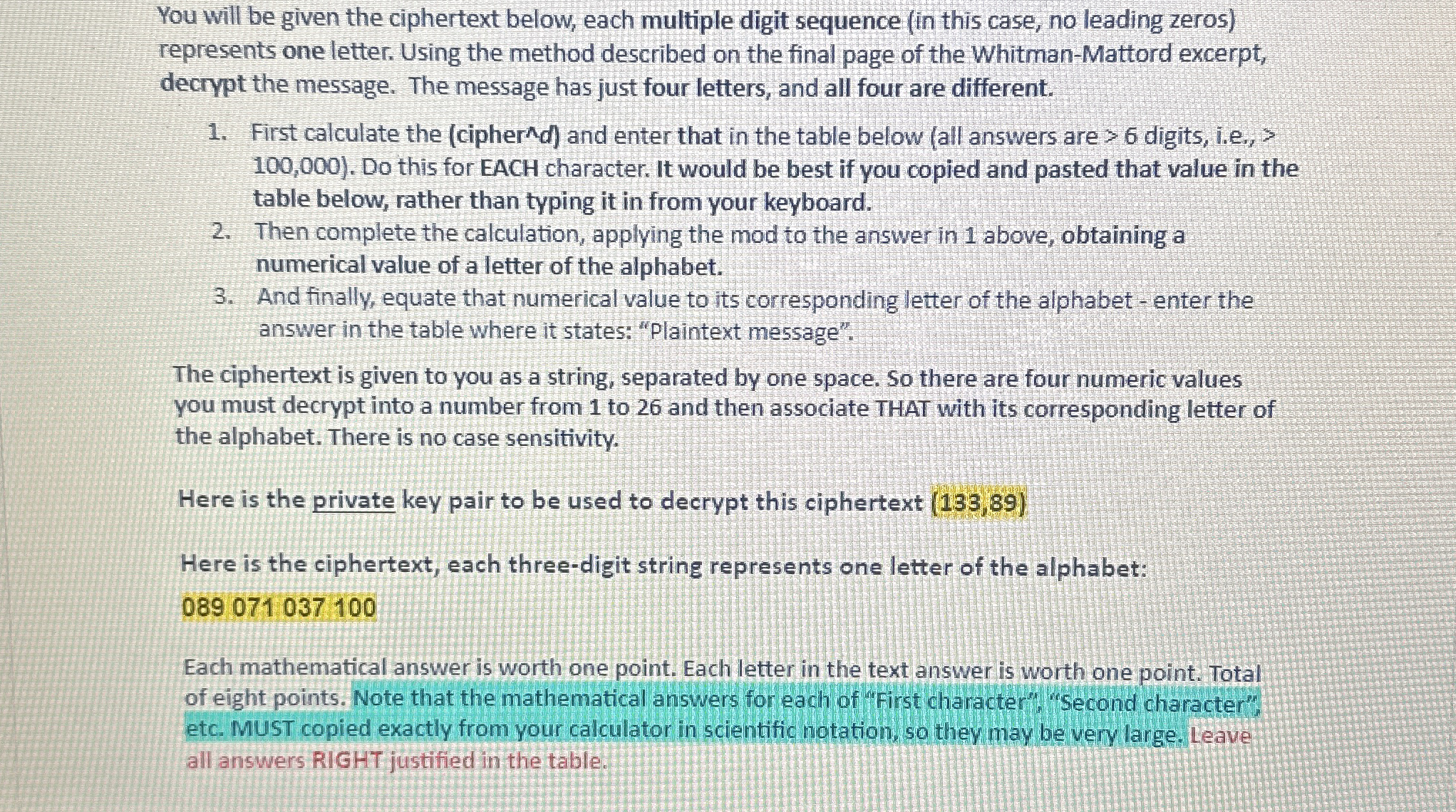
Question: You will be given the ciphertext below, each multiple digit sequence ( in this case, no leading zeros ) represents one letter. Using the method
You will be given the ciphertext below, each multiple digit sequence in this case, no leading zeros
represents one letter. Using the method described on the final page of the WhitmanMattord excerpt,
decrypt the message. The message has just four letters, and all four are different.
First calculate the cipher and enter that in the table below all answers are digits, ie
Do this for EACH character. It would be best if you copied and pasted that value in the
table below, rather than typing it in from your keyboard.
Then complete the calculation, applying the mod to the answer in above, obtaining a
numerical value of a letter of the alphabet.
And finally, equate that numerical value to its corresponding letter of the alphabet enter the
answer in the table where it states: "Plaintext message".
The ciphertext is given to you as a string, separated by one space. So there are four numeric values
you must decrypt into a number from to and then associate THAT with its corresponding letter of
the alphabet. There is no case sensitivity
Here is the private key pair to be used to decrypt this ciphertext
Here is the ciphertext, each threedigit string represents one letter of the alphabet:
Each mathematical answer is worth one point. Each letter in the text answer is worth one point. Total
of eight points. Note that the mathematical answers for each of "First character", "Second character",
etc. MUST copied exactly from your calculator in scientific notation, so they may be very large. Leave
all answers RIGHT justified in the table.
Step by Step Solution
There are 3 Steps involved in it
1 Expert Approved Answer
Step: 1 Unlock

Question Has Been Solved by an Expert!
Get step-by-step solutions from verified subject matter experts
Step: 2 Unlock
Step: 3 Unlock
 Study Help