







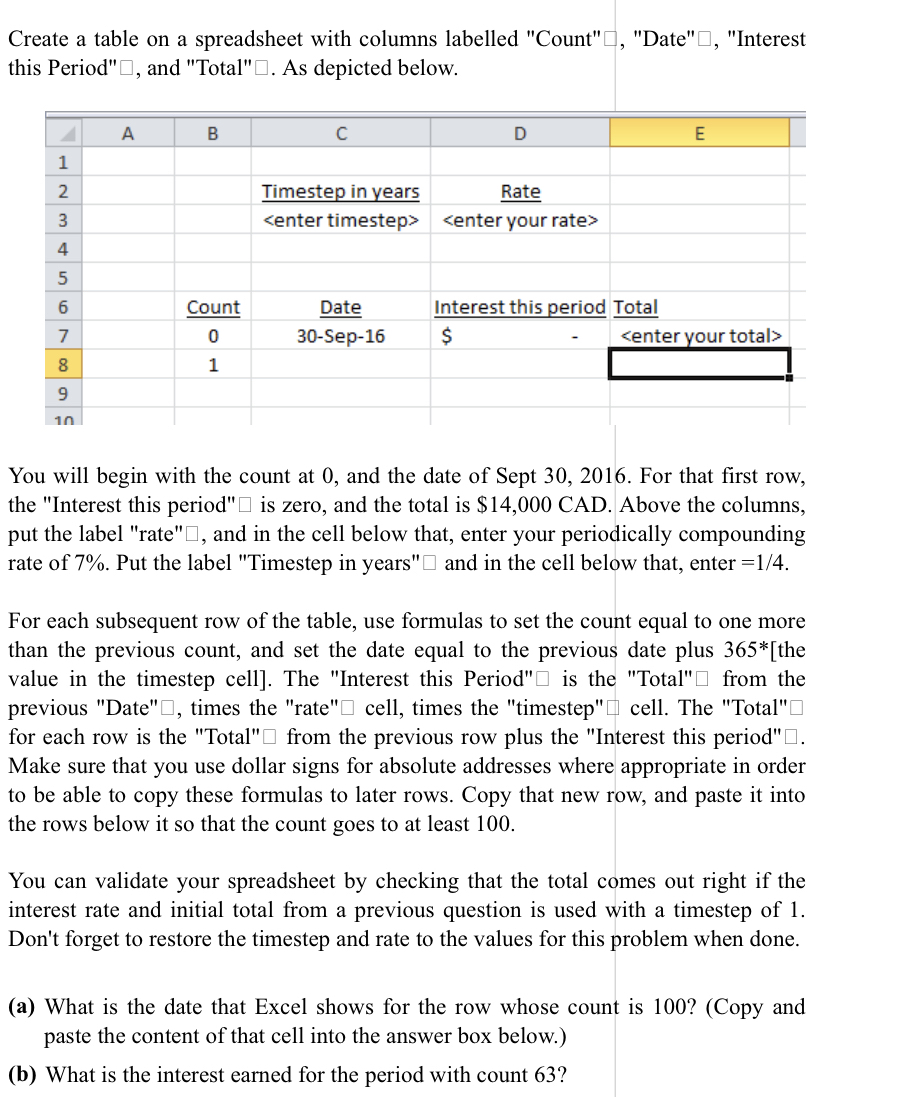
Question: You will begin with the count at 0 , and the date of Sept 3 0 , 2 0 1 6 . For that first
You will begin with the count at and the date of Sept For that first row,
the "Interest this period" is zero, and the total is $ CAD. Above the columns,
put the label "rate" and in the cell below that, enter your periodically compounding
rate of Put the label "Timestep in years" and in the cell below that, enter
For each subsequent row of the table, use formulas to set the count equal to one more
than the previous count, and set the date equal to the previous date plus the
value in the timestep cell The "Interest this Period" is the "Total" from the
previous "Date" times the "rate" cell, times the "timestep" cell. The "Total'
for each row is the "Total" from the previous row plus the "Interest this period"
Make sure that you use dollar signs for absolute addresses where appropriate in order
to be able to copy these formulas to later rows. Copy that new row, and paste it into
the rows below it so that the count goes to at least
You can validate your spreadsheet by checking that the total comes out right if the
interest rate and initial total from a previous question is used with a timestep of
Don't forget to restore the timestep and rate to the values for this problem when done.
a What is the date that Excel shows for the row whose count is Copy and
paste the content of that cell into the answer box below.
b What is the interest earned for the period with count
You will begin with the count at and the date of Sept For that first row,
the "Interest this period" is zero, and the total is $ CAD. Above the columns,
put the label "rate" and in the cell below that, enter your periodically compounding
rate of Put the label "Timestep in years" and in the cell below that, enter
For each subsequent row of the table, use formulas to set the count equal to one more
than the previous count, and set the date equal to the previous date plus the
value in the timestep cell The "Interest this Period" is the "Total" from the
previous "Date" times the "rate" cell, times the "timestep" cell. The "Total'
for each row is the "Total" from the previous row plus the "Interest this period"
Make sure that you use dollar signs for absolute addresses where appropriate in order
to be able to copy these formulas to later rows. Copy that new row, and paste it into
the rows below it so that the count goes to at least
You can validate your spreadsheet by checking that the total comes out right if the
interest rate and initial total from a previous question is used with a timestep of
Don't forget to restore the timestep and rate to the values for this problem when done.
a What is the date that Excel shows for the row whose count is Copy and
paste the content of that cell into the answer box below.
b What is the interest earned for the period with count
Step by Step Solution
There are 3 Steps involved in it
1 Expert Approved Answer
Step: 1 Unlock

Question Has Been Solved by an Expert!
Get step-by-step solutions from verified subject matter experts
Step: 2 Unlock
Step: 3 Unlock
 Study Help