







Question: You will create a program that will use cstring functions to determine if inputted cstrings into an array is a palindrome or not. In main,
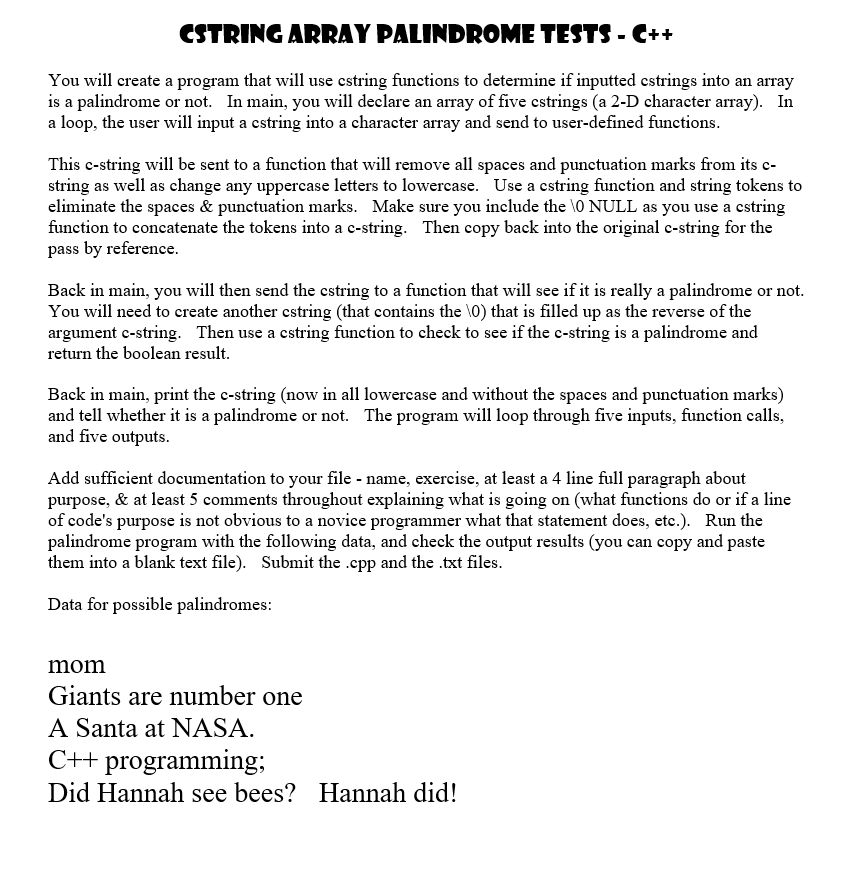
You will create a program that will use cstring functions to determine if inputted cstrings into an array is a palindrome or not. In main, you will declare an array of five cstrings (a 2-D character array). In a loop, the user will input a cstring into a character array and send to user-defined functions. This c-string will be sent to a function that will remove all spaces and punctuation marks from its cstring as well as change any uppercase letters to lowercase. Use a cstring function and string tokens to eliminate the spaces \& punctuation marks. Make sure you include the 10 NULL as you use a cstring function to concatenate the tokens into a c-string. Then copy back into the original c-string for the pass by reference. Back in main, you will then send the cstring to a function that will see if it is really a palindrome or not. You will need to create another cstring (that contains the \0 ) that is filled up as the reverse of the argument c-string. Then use a cstring function to check to see if the c-string is a palindrome and return the boolean result. Back in main, print the c-string (now in all lowercase and without the spaces and punctuation marks) and tell whether it is a palindrome or not. The program will loop through five inputs, function calls, and five outputs. Add sufficient documentation to your file - name, exercise, at least a 4 line full paragraph about purpose, \& at least 5 comments throughout explaining what is going on (what functions do or if a line of code's purpose is not obvious to a novice programmer what that statement does, etc.). Run the palindrome program with the following data, and check the output results (you can copy and paste them into a blank text file). Submit the .cpp and the .txt files
Step by Step Solution
There are 3 Steps involved in it

Get step-by-step solutions from verified subject matter experts
 Study Help