







Question: You will implement the command chunk to divide a large file (filename.txt) into files of 1,000 lines each. At the UNIX shell prompt, your command
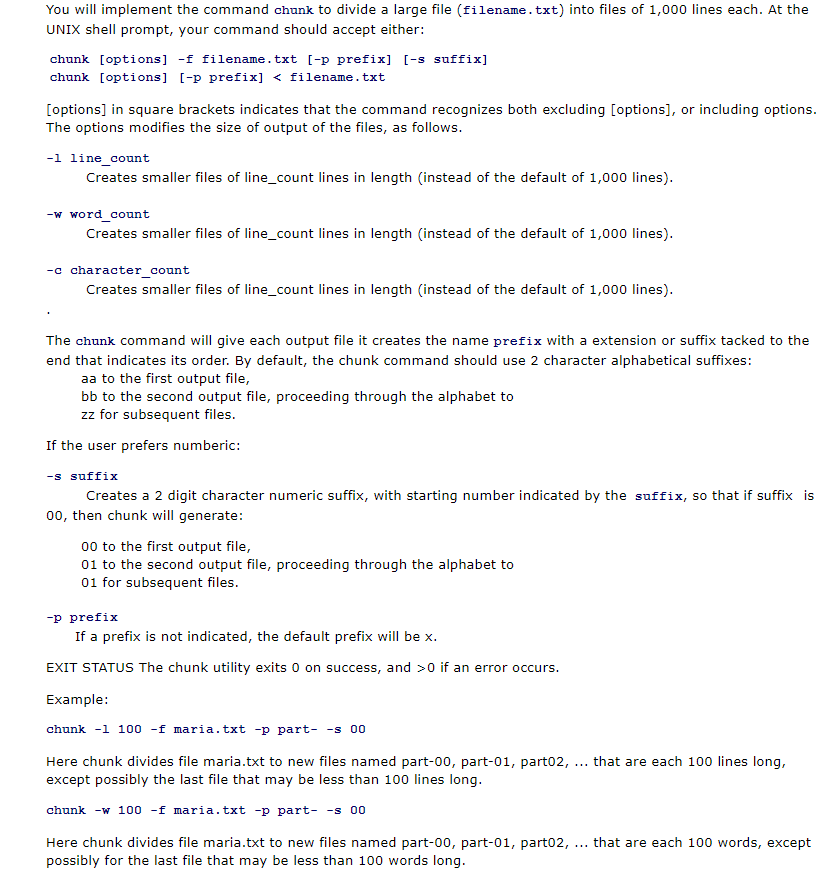
You will implement the command chunk to divide a large file (filename.txt) into files of 1,000 lines each. At the UNIX shell prompt, your command should accept either: chunk [options] -f filename.txt [-p prefix] [-s suffix] chunk [options] [-p prefix] 0 if an error occurs. Example: chunk -1 100 -f maria.txt -p part- -s 00 Here chunk divides file maria.txt to new files named part-00, part-01, parto2, ... that are each 100 lines long, except possibly the last file that may be less than 100 lines long. chunk -w 100 -f maria.txt -p part- -s 00 Here chunk divides file maria.txt to new files named part-00, part-01, parto2, that are each 100 words, except possibly for the last file that may be less than 100 words long. You will implement the command chunk to divide a large file (filename.txt) into files of 1,000 lines each. At the UNIX shell prompt, your command should accept either: chunk [options] -f filename.txt [-p prefix] [-s suffix] chunk [options] [-p prefix] 0 if an error occurs. Example: chunk -1 100 -f maria.txt -p part- -s 00 Here chunk divides file maria.txt to new files named part-00, part-01, parto2, ... that are each 100 lines long, except possibly the last file that may be less than 100 lines long. chunk -w 100 -f maria.txt -p part- -s 00 Here chunk divides file maria.txt to new files named part-00, part-01, parto2, that are each 100 words, except possibly for the last file that may be less than 100 words long
Step by Step Solution
There are 3 Steps involved in it

Get step-by-step solutions from verified subject matter experts
 Study Help