







Question: You will now apply what you have learned about density to attempt to answer the following question: Why does a metal boat float? Surely
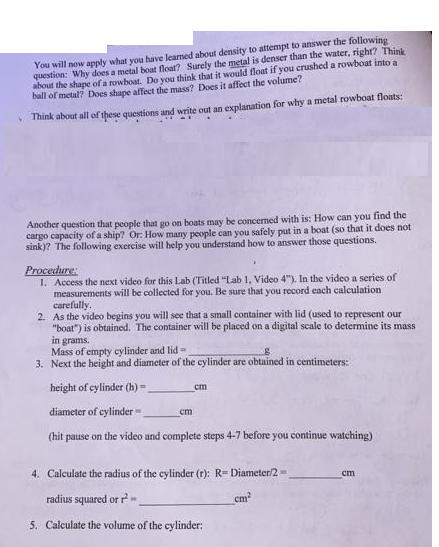
You will now apply what you have learned about density to attempt to answer the following question: Why does a metal boat float? Surely the metal is denser than the water, right? Think about the shape of a rowboat. Do you think that it would float if you crushed a rowboat into a ball of metal? Does shape affect the mass? Does it affect the volume? Think about all of these questions and write out an explanation for why a metal rowboat floats: Another question that people that go on boats may be concerned with is: How can you find the cargo capacity of a ship? Or: How many people can you safely put in a boat (so that it does not sink)? The following exercise will help you understand how to answer those questions. Procedure: 1. Access the next video for this Lab (Titled "Lab 1, Video 4"). In the video a series of measurements will be collected for you. Be sure that you record each calculation carefully. 2. As the video begins you will see that a small container with lid (used to represent our "boat") is obtained. The container will be placed on a digital scale to determine its mass in grams. Mass of empty cylinder and lid - 3. Next the height and diameter of the cylinder are obtained in centimeters: height of cylinder (h). diameter of cylinder- (hit pause on the video and complete steps 4-7 before you continue watching) cm cm 4. Calculate the radius of the cylinder (r): R= Diameter/2- radius squared or r- 5. Calculate the volume of the cylinder: cm cm
Step by Step Solution
3.54 Rating (161 Votes )
There are 3 Steps involved in it

Get step-by-step solutions from verified subject matter experts
 Study Help