







Question: You will still evaluate y = ax + b + c and print the results, for: 2 (0.0, 1.0, 2.0,3.0,..., 10.0) 2 (1.0,0.1,0.01,...,0.00000001) 2 (1.0,
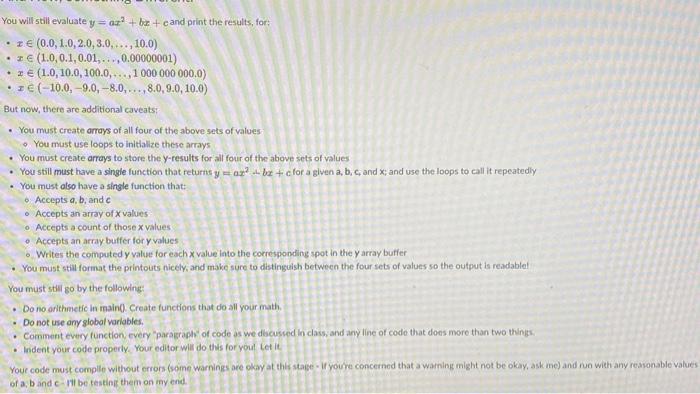
You will still evaluate y = ax + b + c and print the results, for: 2 (0.0, 1.0, 2.0,3.0,..., 10.0) 2 (1.0,0.1,0.01,...,0.00000001) 2 (1.0, 10.0, 1000, 1000 000 000.0) 3 (-10.0, -9,0,-8.0..., 8.0,9.0,10.0) But now, there are additional caveats You must create arrays of all four of the above sets of values You must use loops to initialize these arrays You must create arrays to store the y-results for all four of the above sets of values You still must have a single function that returns y = bx + c for a given a, b, c, and X; and use the loops to call it repeatedly You must also have a single function that: Accepts a, b, and Accepts an array of x values Accepts a count of those x values Accepts an array buffer for y values Writes the computed y value for each x value into the corresponding spot in the y array buffer You must still format the printouts nicely, and make sure to distinguish between the four sets of values so the output is readable! You must still go by the following: Do no arithmetic In main(). Create functions that do all your math, . Do not use any global variables, Comment every function, every paragraph of code as we dbcussed in class, and any line of code that does more than two things Indent your code properly. Your editor will do this for you! Let it Your code must compile without errors (some warnings are okay at this stageIf you've concerned that a warning might not be okay, ask me and run with any reasonable values of a, band be testing them on my end
Step by Step Solution
There are 3 Steps involved in it

Get step-by-step solutions from verified subject matter experts
 Study Help