



Question: You wish to determine if there is a linear correlation between the two variables at a significance level of o = 0.01. You have the
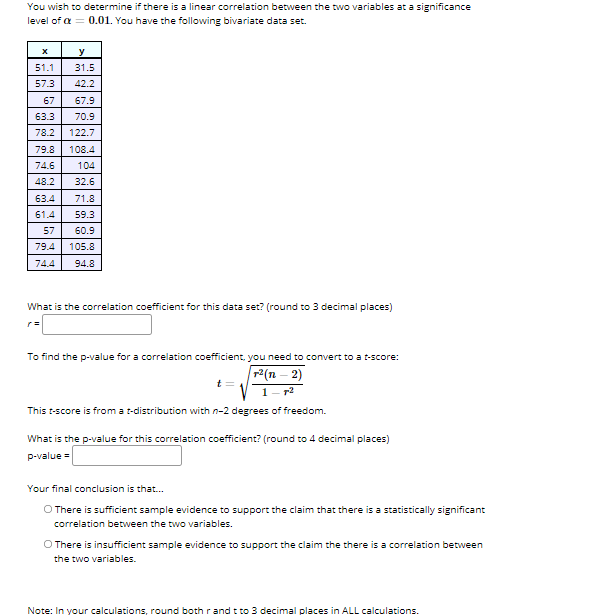
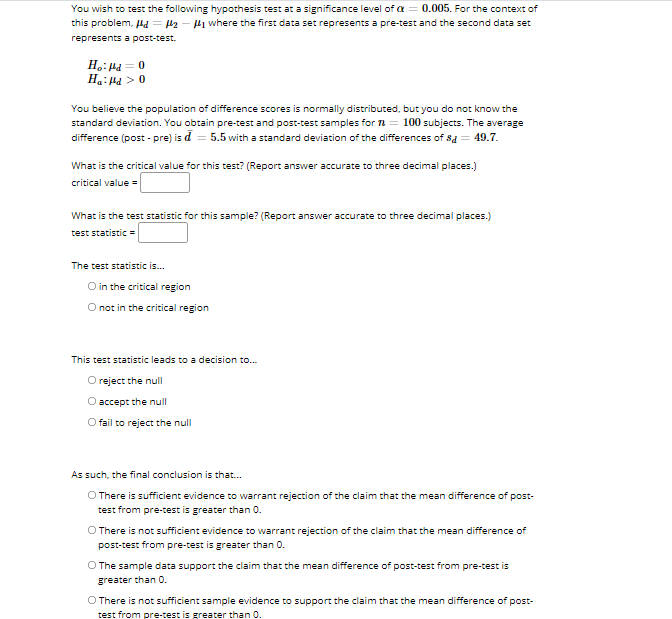
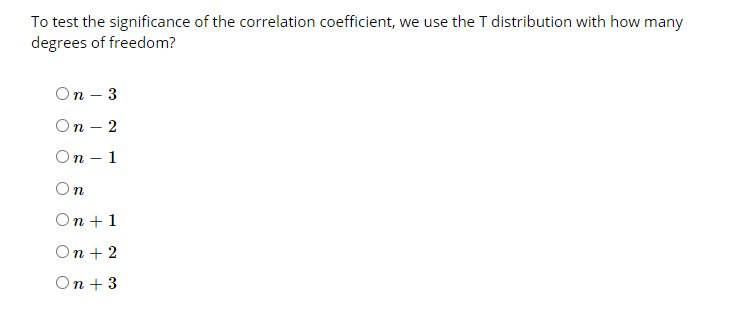
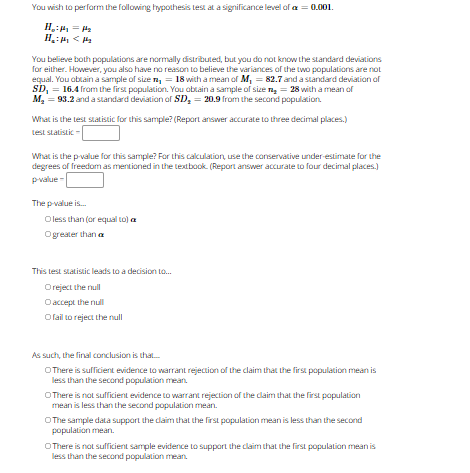
You wish to determine if there is a linear correlation between the two variables at a significance level of o = 0.01. You have the following bivariate data set. X y 51.1 31.5 573 42.2 67 67.9 63.E 70.9 78.2 122.7 79.8 103.4 74.6 104 48.2 32.6 63.4 71.8 61.4 59. 57 60.9 79.4 105.8 74.4 94.8 What is the correlation coefficient for this data set? (round to 3 decimal places) r= To find the p-value for a correlation coefficient, you need to convert to a t-score: (n - 2) - 72 This t-score is from a t-distribution with n-2 degrees of freedom. What is the p-value for this correlation coefficient? (round to 4 decimal places) p-value = Your final conclusion is that.. O There is sufficient sample evidence to support the claim that there is a statistically significant correlation between the two variables. O There is insufficient sample evidence to support the claim the there is a correlation between the two variables.You wish to test the following hypothesis test at a significance level of o = 0.005. For the context of this problem, Ad = /2 - Mi where the first data set represents a pre-test and the second data set represents a post-test. Hold = 0 Ha:Ad >0 You believe the population of difference scores is normally distributed, but you do not know the standard deviation. You obtain pre-test and post-test samples for 1 = 100 subjects. The average difference (post - pre) is d = 5.5 with a standard deviation of the differences of $4 = 49.7. What is the critical value for this test? (Report answer accurate to three decimal places.) critical value = What is the test statistic for this sample? (Report answer accurate to three decimal places.) test statistic = The test statistic is... O in the critical region O not in the critical region This test statistic leads to a decision to... O reject the null O accept the null O fail to reject the null As such, the final conclusion is that.. O There is sufficient evidence to warrant rejection of the claim that the mean difference of post- test from pre-test is greater than 0. O There is not sufficient evidence to warrant rejection of the claim that the mean difference of post-test from pre-test is greater than 0. O The sample data support the claim that the mean difference of post-test from pre-test is greater than 0. There is not sufficient sample evidence to support the claim that the mean difference of post-To test the significance of the correlation coefficient, we use the T distribution with how many degrees of freedom? On - 3 On - 2 On - 1 On On+1 On + 2 On + 3You wish to perform the following hypothesis test at a significance level of a = 0.0101. You believe both populations are normally distributed, but you do not know the standard deviations for either. However, you also have no reason to believe the variances of the two populations are not equal. You obtain a sample of size n = 18 with a mean of M, = 82.7 and a standard deviation of SD, = 16.4 from the first population. You obtain a sample of size ny = 28 with a mean of My = 93.2 and a standard deviation of SID, = 20.9 from the second population. What is the test statistic for this sample? (Report answer accurate to three decimal places.) let statistic - What is the p-value for this sample? For this calculation, use the conservative under estimate for the degrees of freedom as mentioned in the textbook. (Report answer accurate to four decimal places.) p-value - The p-value is.. O less than (or equal to] a O greater than a This test statistic leads to a decision to... O reject the null O accept the null Ofail to reject the null As such, the final conclusion is that. Q There is sufficient evidence to warrant rejection of the claim that the first population mean is less than the second population mean. O There is not sufficient evidence to warrant rejection of the claim that the first population mean is less than the second population mean. O The sample data support the claim that the first population mean is less than the second population mean. O There is not sufficient sample evidence to support the claim that the first population mean is less than the second population mean
Step by Step Solution
There are 3 Steps involved in it

Get step-by-step solutions from verified subject matter experts