Question: Your and compound inequality is : 4 ? 2 + 4x ? 16 Your or compound inequality is : x + 2 Please solve the

Your "and" compound inequality is:

4 ? 2 + 4x ? 16

Your "or" compound inequality is:

x + 2

  1. Please solve the compound inequalities but be careful of how a negative x-term is handled in the solving process.
  2. Please show all math work arriving at the solutions.
  3. Please show the solution sets written algebraically and as a union or intersection of intervals.
  4. Describe in words what the solution sets mean, and then display a simple line graph for each solution set

Please incorporate the following terms into your explanation and reasoning.

  • Compound inequalities
  • And
  • Or
  • Intersection
  • Union

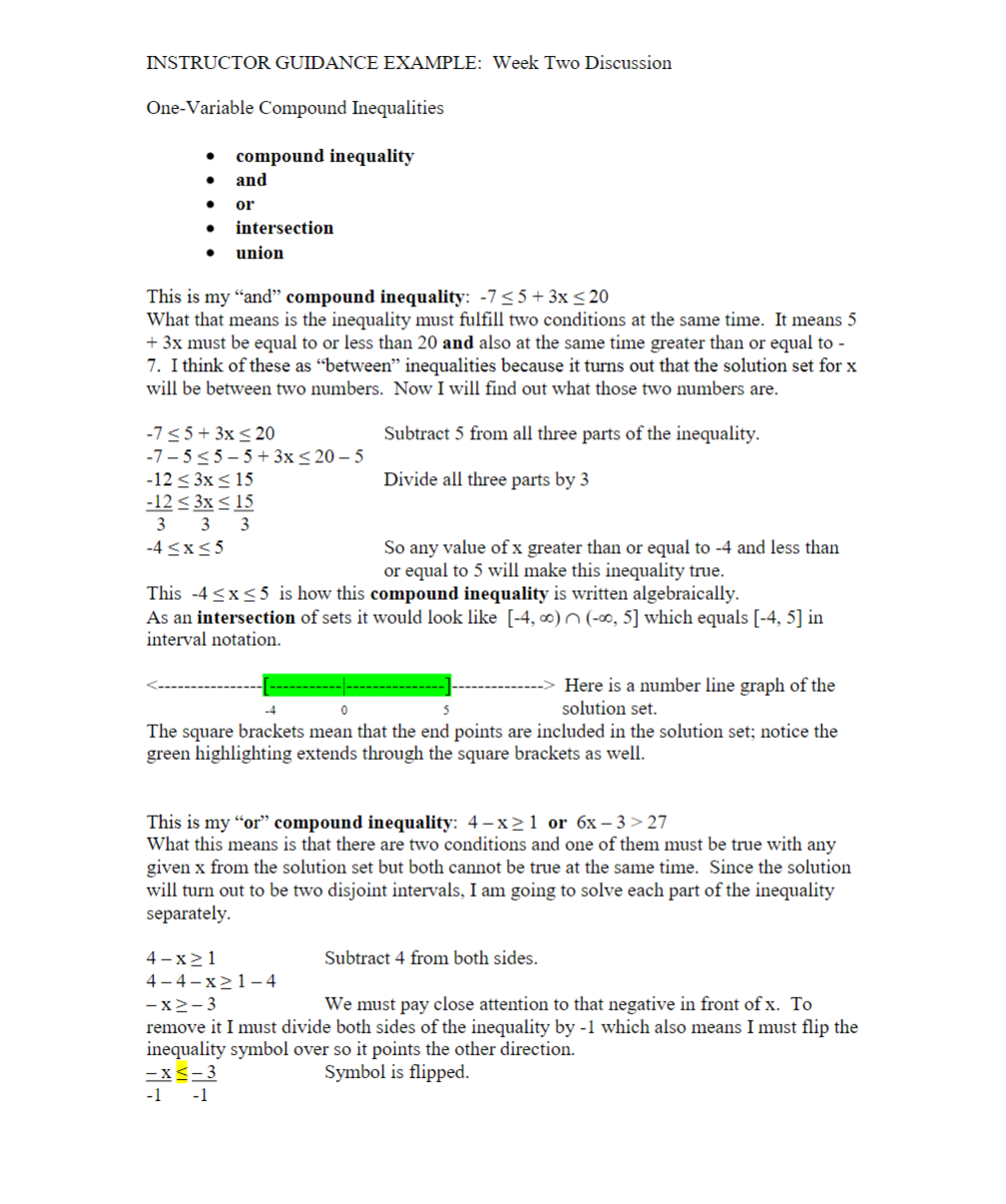
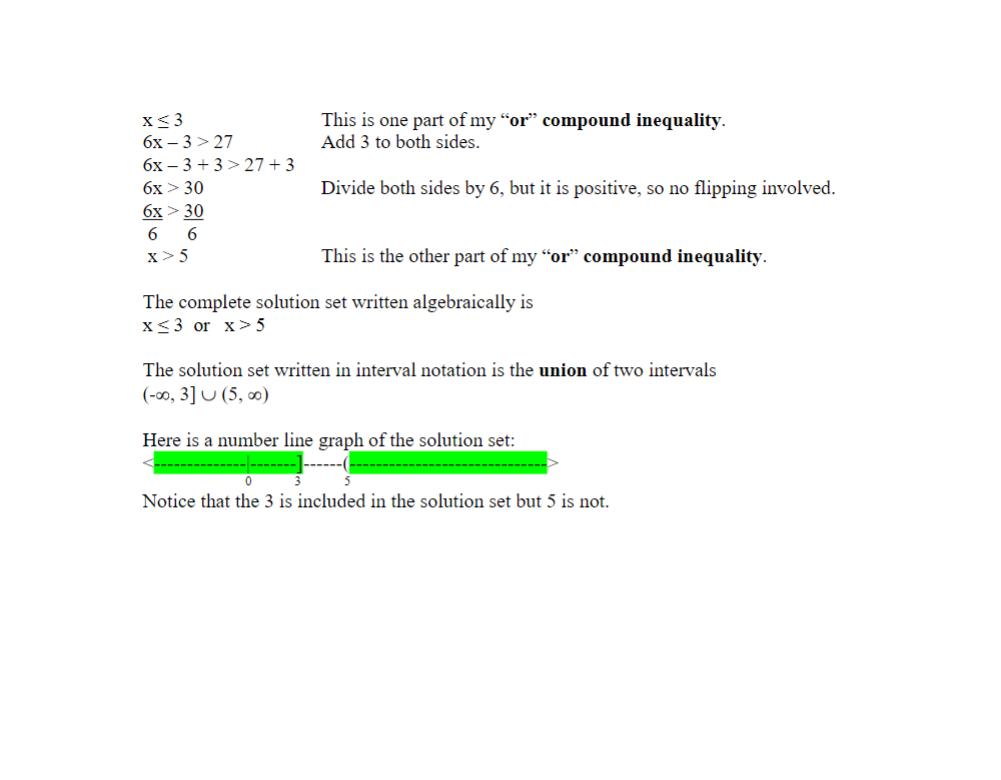
I have included an example.

Your "and" compound inequality is : 4 ? 2 + 4x ?Your "and" compound inequality is : 4 ? 2 + 4x ?
INSTRUCTOR GUIDANCE EXAMPLE: Week Two Discussion One-Variable Compound Inequalities compound inequality and or intersection union .0... This is my \"and\" compound inequality: -7 :1 5 + 3x 3 20 What that means is the inequality must fulfill two conditions at the same time. It means 5 + 3:: must be equal to or less than 20 and also at the same time greater than or equal to - 7. I think of these as \"between\" inequalities because it turns out that the solution set for x will be between two numbers. Now I will nd out what those two numbers are. -? 5 5 + 3x 5 20 Subtract 5 from all three parts of the inequality. -?5555+3x5205 -12 5 3x 5 15 Divide all three parts by 3 'E 3_X E 15 3 3 3 -4 5 x 5 5 So any value of x greater than or equal to -4 and less than or equal to 5 will make this inequality true. This -4 S x 5 5 is how this compound inequality is written algebraically. As an intersection of sets it would look like [-4. ac) n [-ac. 5] which equals [-4. 5] in interval notation. a"------------------------------?- Here is a number line graph of the .4 o 5 solution set. The square brackets mean that the end points are included in the solution set: notice the green highlighting extends through the square brackets as well. This is my \"or\" compound inequality: 4 x 2 1 or x 3 i? 27 What this means is that there are two conditions and one of them must be true with any given 3 from the solution set but both cannot be true at the same time. Since the solution will turn out to be two disjoint intervals. I am going to solve each part of the inequality separately. 4 x 2 l Subtract 4 from both sides. 44xEl4 x 23 3 We must pay close attention to that negative in front of x. To remove it I must divide both sides of the inequality by l which also means Imust ip the inequality symbol over so it points the other direction. _X S _3 Symbol is ipped. l l x :1 3 This is one part of my \"or\" compound inequality. 6);- 3 >' 27 Add 3 to both sides. 6); 3 + 3 I) 27 + 3 6); > 30 Divide both sides by 6, but it is positive, so no ipping involved. E > E 6 6 x 3* 5 This is the other part of my \"01'" compound inequality. The complete solution set written algebraically is x S 3 or x > 5 The solution set written in interval notation is the union of two intervals (-00. 3] u {5. on) Here is a number line graph of the solution set: <_-----t_ o notice that the is included in solution set but not>

Step by Step Solution

There are 3 Steps involved in it

1 Expert Approved Answer
Step: 1 Unlock blur-text-image

Question Has Been Solved by an Expert!

Get step-by-step solutions from verified subject matter experts

Step: 2 Unlock
Step: 3 Unlock

Students Have Also Explored These Related Mathematics Questions!