Question: Your assignment is to use Java to write a recursive descent parser for a simplified HTML language. The lexical syntax is specified by regular expressions
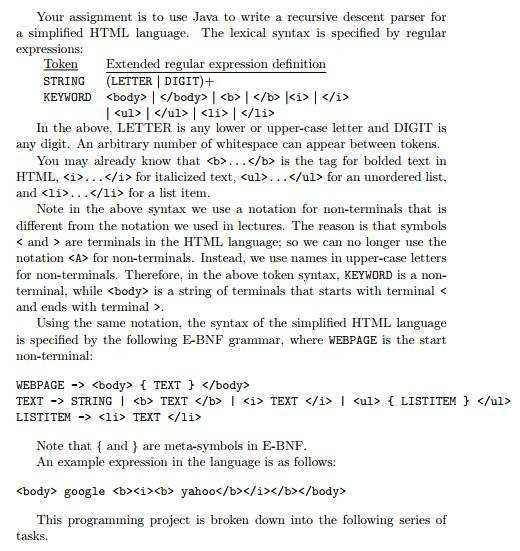
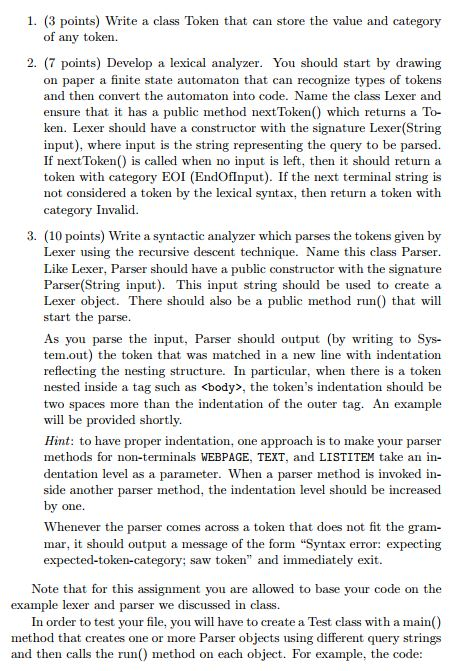
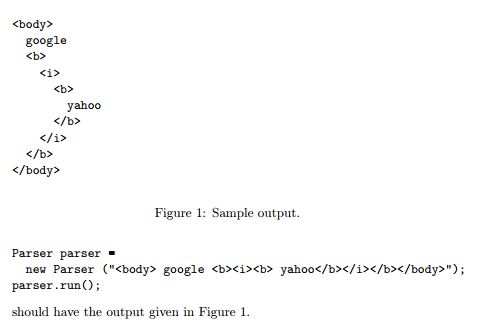
Your assignment is to use Java to write a recursive descent parser for a simplified HTML language. The lexical syntax is specified by regular expressions definition Token Extended regular e STRING (LETTER | DIGIT)+ KEYWORD | | In the above, LETTER is any lower or upper-case letter and DIGIT is any digit. An arbitrary number of whitespace can appear between tokens. You may already know that . is the tag for bolded text in HTML, .. . for italicized text,
for an uordered list and
. . for a list item. Note in the above syntax we use a notation for non-terminals that is different from the notation we used in lectures. The reason is that symbols for non-terminals. Instead, we use names in upper-case letters for non-terminals. Therefore, in the above token syntax, KEYWORD is a non terminal, while is a string of terminals that starts with terminal Using the same notation, the syntax of the simplified HTML language is specified by the following E-BNF grammar, where WEBPAGE is the start non-terminal: WEBPAGE-> TEXT TEXT-> STRING | TEXT I TEXT | LISTITEM - TEXT 1i> Note that and are meta-symbols in E-BNF An example expression in the language is as follows: google yahoo/x/i/> This programming project is broken down into the following series of tasks. Your assignment is to use Java to write a recursive descent parser for a simplified HTML language. The lexical syntax is specified by regular expressions definition Token Extended regular e STRING (LETTER | DIGIT)+ KEYWORD | | In the above, LETTER is any lower or upper-case letter and DIGIT is any digit. An arbitrary number of whitespace can appear between tokens. You may already know that . is the tag for bolded text in HTML, .. . for italicized text, for an uordered list and . . for a list item. Note in the above syntax we use a notation for non-terminals that is different from the notation we used in lectures. The reason is that symbols for non-terminals. Instead, we use names in upper-case letters for non-terminals. Therefore, in the above token syntax, KEYWORD is a non terminal, while is a string of terminals that starts with terminal Using the same notation, the syntax of the simplified HTML language is specified by the following E-BNF grammar, where WEBPAGE is the start non-terminal: WEBPAGE-> TEXT TEXT-> STRING | TEXT I TEXT | LISTITEM - TEXT 1i> Note that and are meta-symbols in E-BNF An example expression in the language is as follows: google yahoo/x/i/> This programming project is broken down into the following series of tasks









 Study Help