







Question: Your case brief should include: Case Name, Citation and Year of Decision Facts Briefly summarize the facts of the case, including the background information and
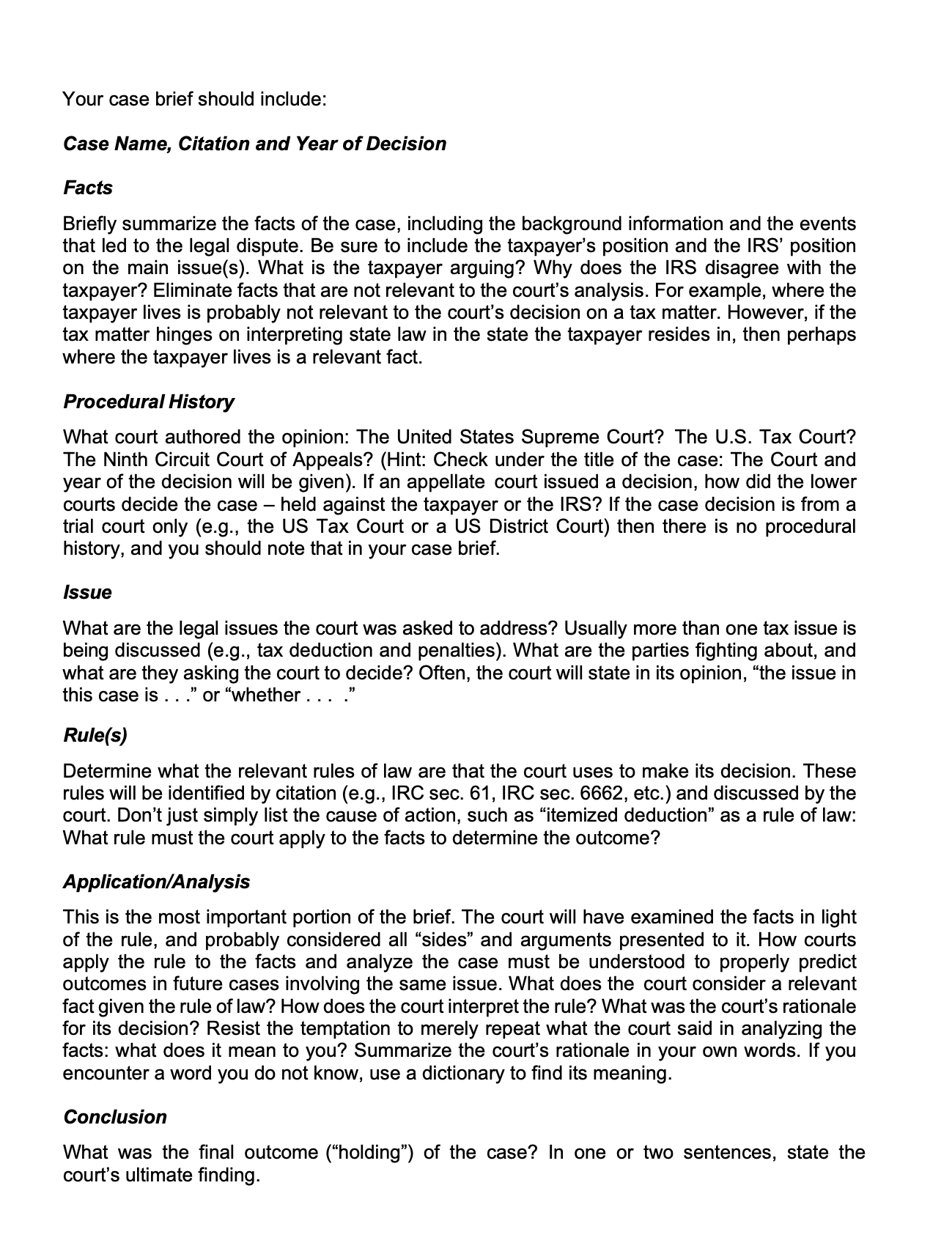
Your case brief should include: Case Name, Citation and Year of Decision Facts Briefly summarize the facts of the case, including the background information and the events that led to the legal dispute. Be sure to include the taxpayer's position and the IRS' position on the main issue(s). What is the taxpayer arguing? Why does the IRS disagree with the taxpayer? Eliminate facts that are not relevant to the court's analysis. For example, where the taxpayer lives is probably not relevant to the court's decision on a tax matter. However, if the tax matter hinges on interpreting state law in the state the taxpayer resides in, then perhaps where the taxpayer lives is a relevant fact. Procedural History What court authored the opinion: The United States Supreme Court? The U.S. Tax Court? The Ninth Circuit Court of Appeals? (Hint: Check under the title of the case: The Court and year of the decision will be given). If an appellate court issued a decision, how did the lower courts decide the case held against the taxpayer or the IRS? If the case decision is from a trial court only (e.g., the US Tax Court or a US District Court) then there is no procedural history, and you should note that in your case brief. Issue What are the legal issues the court was asked to address? Usually more than one tax issue is being discussed (e.g., tax deduction and penalties). What are the parties fighting about, and what are they asking the court to decide? Often, the court will state in its opinion, \"the issue in this case is . . .\" or \"whether . . . " Rule(s) Determine what the relevant rules of law are that the court uses to make its decision. These rules will be identified by citation (e.g., IRC sec. 61, IRC sec. 6662, etc.) and discussed by the court. Don't just simply list the cause of action, such as \"itemized deduction\" as a rule of law: What rule must the court apply to the facts to determine the outcome? Application/Analysis This is the most important portion of the brief. The court will have examined the facts in light of the rule, and probably considered all \"sides\" and arguments presented to it. How courts apply the rule to the facts and analyze the case must be understood to properly predict outcomes in future cases involving the same issue. What does the court consider a relevant fact given the rule of law? How does the court interpret the rule? What was the court's rationale for its decision? Resist the temptation to merely repeat what the court said in analyzing the facts: what does it mean to you? Summarize the court's rationale in your own words. If you encounter a word you do not know, use a dictionary to find its meaning. Conclusion What was the final outcome (\"holding\") of the case? In one or two sentences, state the court's ultimate finding
Step by Step Solution
There are 3 Steps involved in it

Get step-by-step solutions from verified subject matter experts
 Study Help