







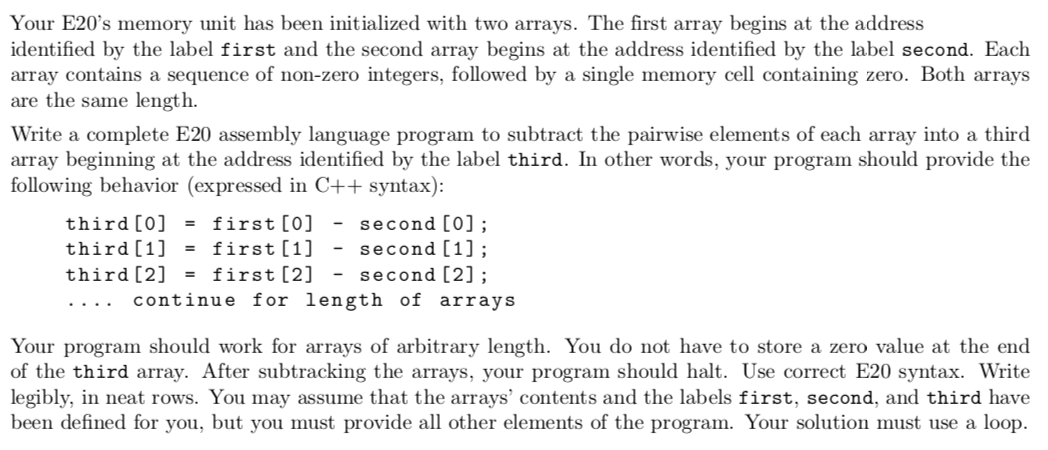
Question: Your E 2 0 ' s memory unit has been initialized with two arrays. The first array begins at the address identified by the label
Your Es memory unit has been initialized with two arrays. The first array begins at the address
identified by the label first and the second array begins at the address identified by the label second. Each
array contains a sequence of nonzero integers, followed by a single memory cell containing zero. Both arrays
are the same length.
Write a complete E assembly language program to subtract the pairwise elements of each array into a third
array beginning at the address identified by the label third. In other words, your program should provide the
following behavior expressed in syntax:
Your program should work for arrays of arbitrary length. You do not have to store a zero value at the end
of the third array. After subtracking the arrays, your program should halt. Use correct E syntax. Write
legibly, in neat rows. You may assume that the arrays' contents and the labels first, second, and third have
been defined for you, but you must provide all other elements of the program. Your solution must use a loop.
Step by Step Solution
There are 3 Steps involved in it
1 Expert Approved Answer
Step: 1 Unlock

Question Has Been Solved by an Expert!
Get step-by-step solutions from verified subject matter experts
Step: 2 Unlock
Step: 3 Unlock
 Study Help