







Question: Your eccentric aunt found out that you are taking Statics and thinks you can help her with a little project. She is moving to a
Your eccentric aunt found out that you are taking Statics and thinks you can help her with a "little" project.
She is moving to a condo in Sarasota, Florida that is smaller than her house. She isn't going to have room
for a desk, but she wants a place where she can pay bills and Zoom with her nieces and nephews. She wants
a folddown desk in her guest room.
She isn't sure how big a desk she wants; she wants you to come up with dimensions that you think would
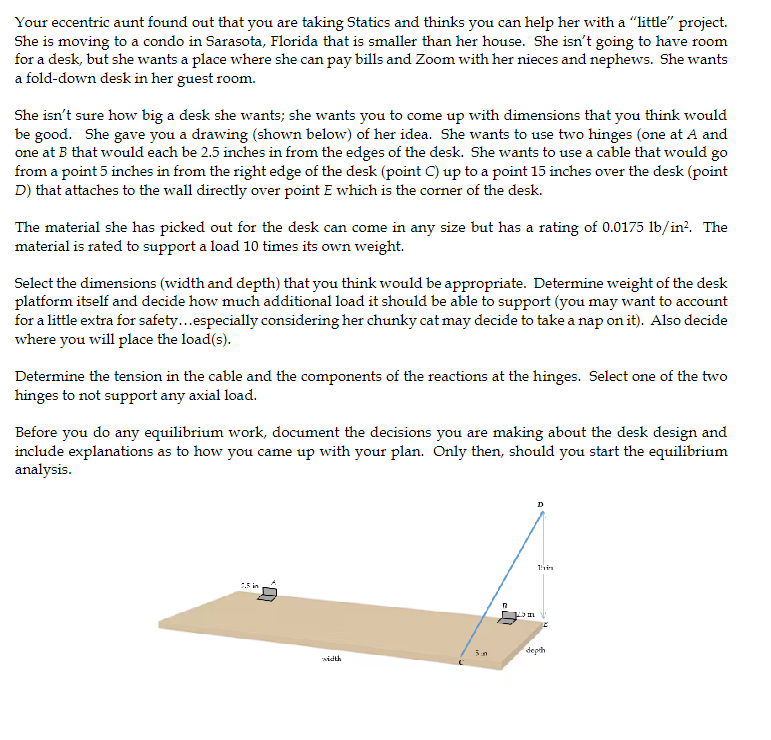
be good. She gave you a drawing shown below of her idea. She wants to use two hinges one at A and
one at that would each be inches in from the edges of the desk. She wants to use a cable that would go
from a point inches in from the right edge of the desk point up to a point inches over the desk point
that attaches to the wall directly over point which is the corner of the desk.
The material she has picked out for the desk can come in any size but has a rating of The
material is rated to support a load times its own weight.
Select the dimensions width and depth that you think would be appropriate. Determine weight of the desk
platform itself and decide how much additional load it should be able to support you may want to account
for a little extra for safety...especially considering her chunky cat may decide to take a nap on it Also decide
where you will place the loads
Determine the tension in the cable and the components of the reactions at the hinges. Select one of the two
hinges to not support any axial load.
Before you do any equilibrium work, document the decisions you are making about the desk design and
include explanations as to how you came up with your plan. Only then, should you start the equilibrium
analysis.
Regardless of what the book gives for answers in the back any time you are asked to solve for the reactions or the
components of the reactions you MUST include magnitude and direction in your answers. The reaction forces are
vectors and need to be expressed as vectors. The one exception to this is when you are asked to find the tension in a
cable as tension values are expressed with magnitude only Use i j k notation to express direction
Step by Step Solution
There are 3 Steps involved in it
1 Expert Approved Answer
Step: 1 Unlock

Question Has Been Solved by an Expert!
Get step-by-step solutions from verified subject matter experts
Step: 2 Unlock
Step: 3 Unlock
 Study Help