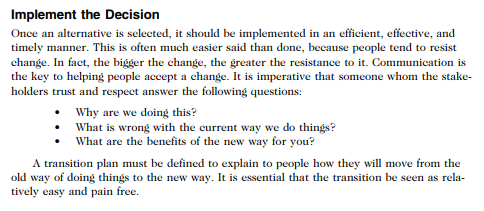
Question: Your job is to make a plan for implementing a decision -( A transition plan must be defined to explain to people how they will
Your job is to make a plan for implementing a decision -(A transition plan must be defined to explain to people how they will move from the old way of doing things to the new way. It is essential that the transition be seen as relatively easy and pain free). The decision I chose is "Developing fair software for sentencing criminals is less risky". First, read the question (9.45). Then, take a look at two pictures that I have uploaded from my textbook. Those two pictures will help you to answer the question. You only need to answer about implementing the decision. Do not forget to answer these three question:
1). Why are we doing this?
2). What is wrong with the current way we do things?
3). What are the benefits of the new way for you?
Please, make sure the answer is correct, well written, and no grammar mistakes. Let me know if you have any questions. Thanks in advance.

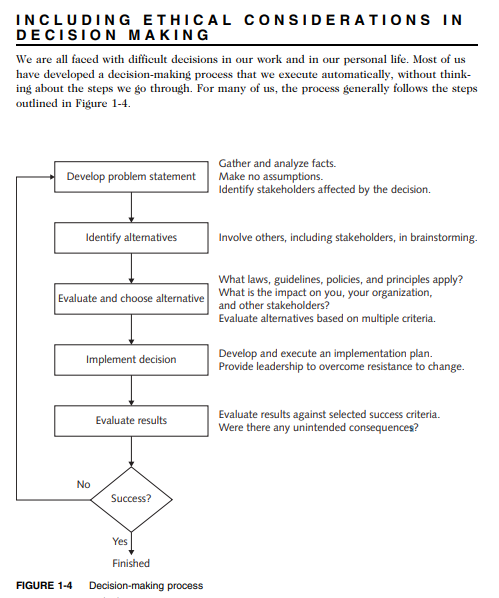
9.45 Which do you think is less risky: developing fair software for sentencing criminals or developing safe software for self-driving cars? Which would you be more comfortable working on? Why? INCLUDING ETHICAL CONSIDERATIONS IN DECISION MAKING We are all faced with difficult decisions in our work and in our personal life. Most of us have developed a decision-making process that we execute automatically, without think- ing about the steps we go through. For many of us, the process generally follows the steps outlined in Figure 1-4. Develop problem statement Gather and analyze facts. Make no assumptions. Identify stakeholders affected by the decision. Identify altematives Involve others, including stakeholders, in brainstorming. What laws, guidelines, policies, and principles apply? Evaluate and choose alternative. What is the impact on you, your organization, and other stakeholders? Evaluate alternatives based on multiple criteria. Implement decision Develop and execute an implementation plan. Provide leadership to overcome resistance to change. Evaluate results Evaluate results against selected success criteria. Were there any unintended consequences? No Success? Yes Finished FIGURE 1-4 Decision-making process Implement the Decision Once an alternative is selected, it should be implemented in an efficient, effective, and timely manner. This is often much easier said than done, because people tend to resist change. In fact, the bigger the change, the greater the resistance to it. Communication is the key to helping people accept a change. It is imperative that someone whom the stake- holders trust and respect answer the following questions: Why are we doing this? What is wrong with the current way we do things? What are the benefits of the new way for you? A transition plan must be defined to explain to people how they will move from the old way of doing things to the new way. It is essential that the transition be seen as rela- tively easy and pain free. 9.45 Which do you think is less risky: developing fair software for sentencing criminals or developing safe software for self-driving cars? Which would you be more comfortable working on? Why? INCLUDING ETHICAL CONSIDERATIONS IN DECISION MAKING We are all faced with difficult decisions in our work and in our personal life. Most of us have developed a decision-making process that we execute automatically, without think- ing about the steps we go through. For many of us, the process generally follows the steps outlined in Figure 1-4. Develop problem statement Gather and analyze facts. Make no assumptions. Identify stakeholders affected by the decision. Identify altematives Involve others, including stakeholders, in brainstorming. What laws, guidelines, policies, and principles apply? Evaluate and choose alternative. What is the impact on you, your organization, and other stakeholders? Evaluate alternatives based on multiple criteria. Implement decision Develop and execute an implementation plan. Provide leadership to overcome resistance to change. Evaluate results Evaluate results against selected success criteria. Were there any unintended consequences? No Success? Yes Finished FIGURE 1-4 Decision-making process Implement the Decision Once an alternative is selected, it should be implemented in an efficient, effective, and timely manner. This is often much easier said than done, because people tend to resist change. In fact, the bigger the change, the greater the resistance to it. Communication is the key to helping people accept a change. It is imperative that someone whom the stake- holders trust and respect answer the following questions: Why are we doing this? What is wrong with the current way we do things? What are the benefits of the new way for you? A transition plan must be defined to explain to people how they will move from the old way of doing things to the new way. It is essential that the transition be seen as rela- tively easy and pain free









 Study Help