



Question: Your research group is working a polymer that can be used as a cell encapsulation device. Your lab works with glibenclamide:PEG and PVA polymers and
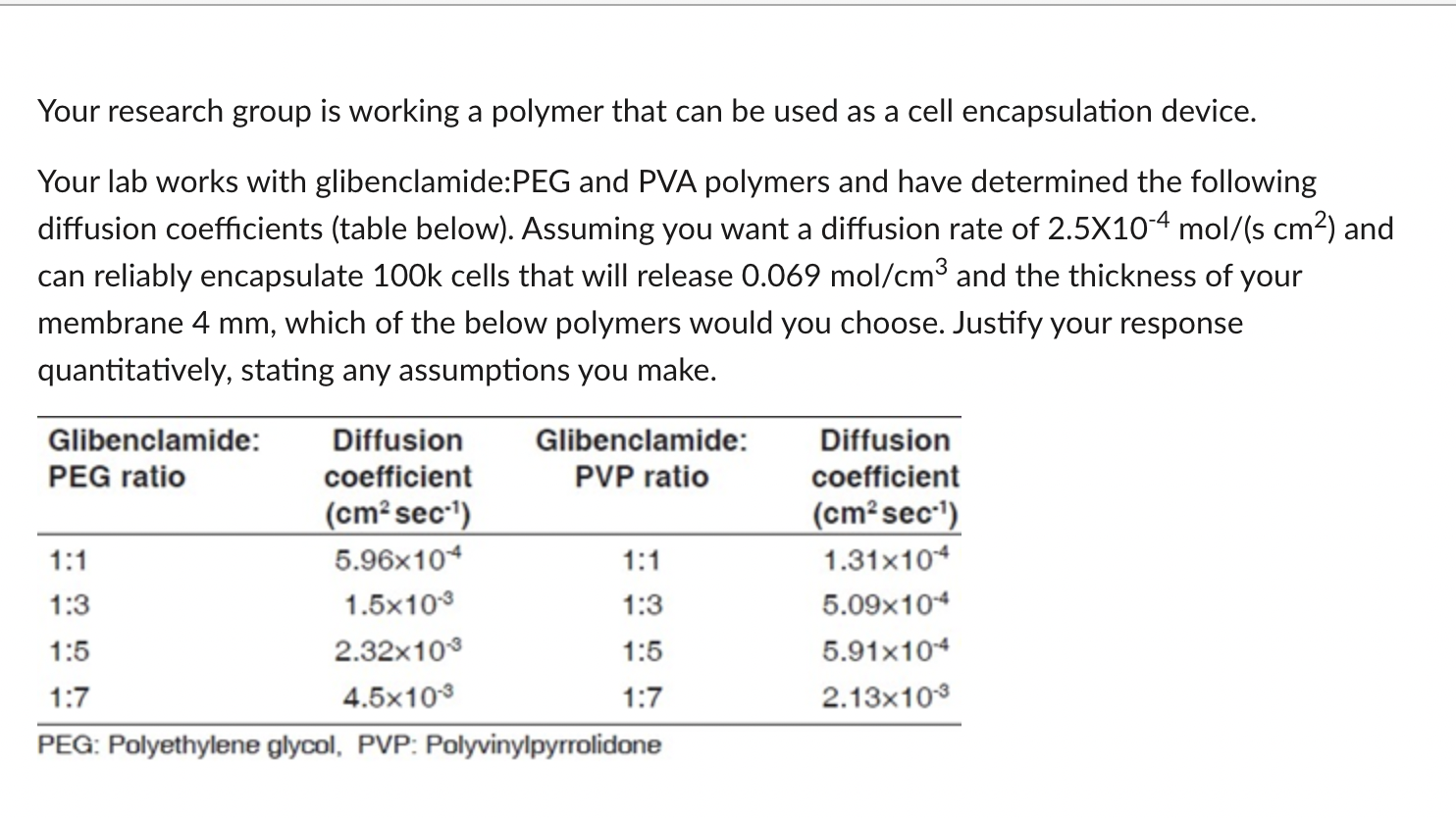
Your research group is working a polymer that can be used as a cell encapsulation device. Your lab works with glibenclamide:PEG and PVA polymers and have determined the following diffusion coefficients (table below). Assuming you want a diffusion rate of 2.5X10⁻⁴ mol/(s cm2) and can reliably encapsulate 100k cells that will release 0.069 mol/cm3 and the thickness of your membrane 4 mm, which of the below polymers would you choose. Justify your response quantitatively, stating any assumptions you make. 1:1 Glibenclamide: Diffusion Glibenclamide: PEG ratio coefficient PVP ratio (cm sec) 1:1 5.96x10⁴ 1:3 1.5x10⁻³ 1:3 1:5 2.32x10³ 1:5 1:7 4.5x10³ 1:7 PEG: Polyethylene glycol, PVP: Polyvinylpyrrolidone Diffusion coefficient (cm sec) 1.31x10⁴ 5.09x10⁻⁴ 5.91x10⁻⁴ 2.13x10⁻³ Your research group is working a polymer that can be used as a cell encapsulation device. Your lab works with glibenclamide:PEG and PVA polymers and have determined the following diffusion coefficients (table below). Assuming you want a diffusion rate of 2.5X10⁻⁴ mol/(s cm2) and can reliably encapsulate 100k cells that will release 0.069 mol/cm3 and the thickness of your membrane 4 mm, which of the below polymers would you choose. Justify your response quantitatively, stating any assumptions you make. 1:1 Glibenclamide: Diffusion Glibenclamide: PEG ratio coefficient PVP ratio (cm sec) 1:1 5.96x10⁴ 1:3 1.5x10⁻³ 1:3 1:5 2.32x10³ 1:5 1:7 4.5x10³ 1:7 PEG: Polyethylene glycol, PVP: Polyvinylpyrrolidone Diffusion coefficient (cm sec) 1.31x10⁴ 5.09x10⁻⁴ 5.91x10⁻⁴ 2.13x10⁻³
Step by Step Solution
There are 3 Steps involved in it

Get step-by-step solutions from verified subject matter experts