







Question: Your solutions should be submitted in the pdf file format as either a digitally written document, scan, or photo that is of adequate quality and
Your solutions should be submitted in the pdf file format as either a digitally written document, scan, or photo that is of adequate quality and resolution for marking. You should use the answer template and do not need a cover sheet. Please underline final answers to numerical questions. You are allowed to draw the flownet on a tablettouch screen. Calculate the average hydraulic gradient between point and the base of the excavation.
mark
Estimate the vertical effective stress at point assuming that the sand has a saturated
unit weight equal to
mark
Explain one way you can alter the proposed excavation andor design of the sheet piles to
achieve an increase in the critical state shear strength of the soil at point The depth of
the excavation cannot be changed. Provide reasoning. Hint:
marks
The soils are now found to have anisotropic permeability, with the horizontal permeability
equal to and the vertical permeability being Calculate the length
scaling factor that should be used to draw the flownet and permeability that should be
used in the calculation of flowrate when the anisotropy is considered.
marks
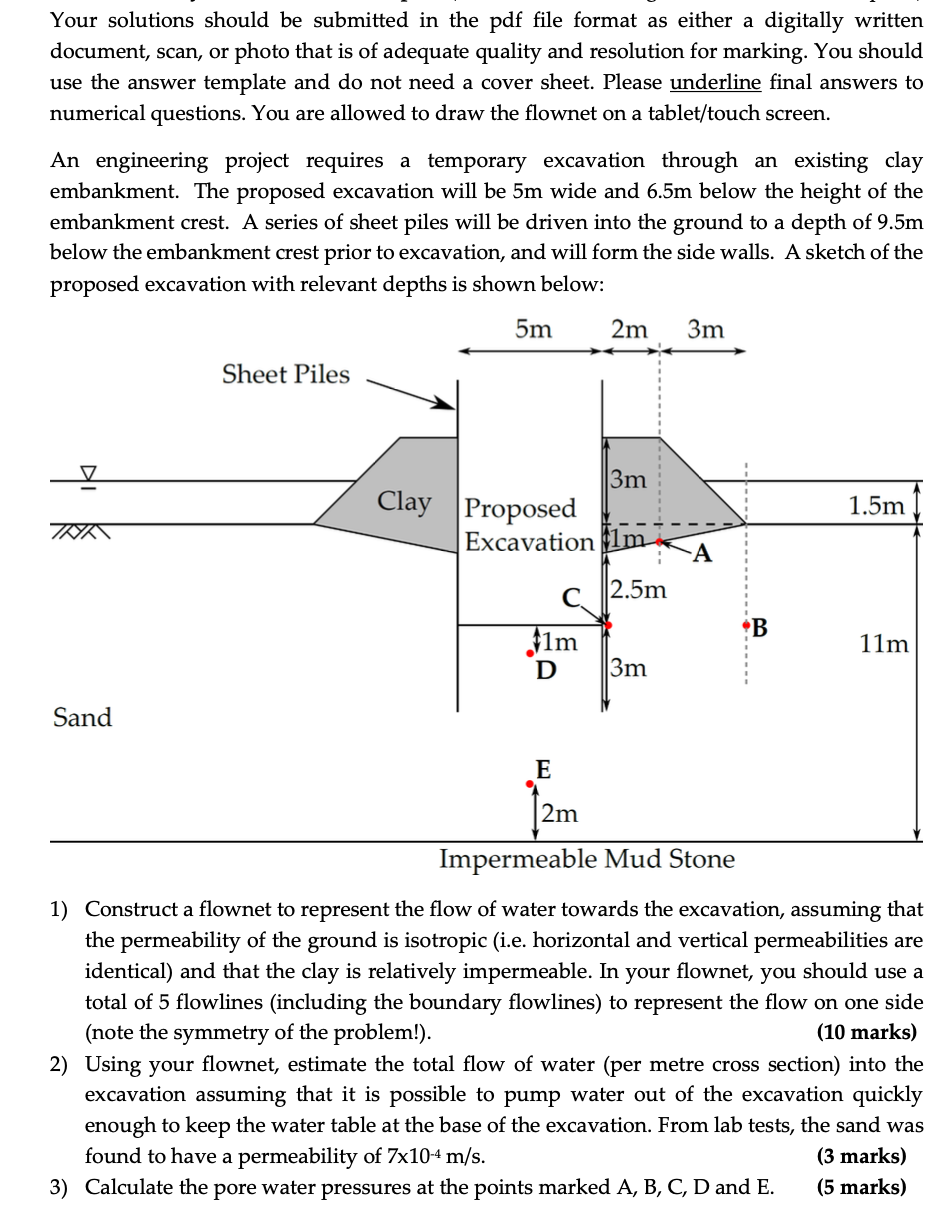
An engineering project requires a temporary excavation through an existing clay embankment. The proposed excavation will be m wide and m below the height of the embankment crest. A series of sheet piles will be driven into the ground to a depth of m below the embankment crest prior to excavation, and will form the side walls. A sketch of the
Construct a flownet to represent the flow of water towards the excavation, assuming that the permeability of the ground is isotropic ie horizontal and vertical permeabilities are identical and that the clay is relatively impermeable. In your flownet, you should use a total of flowlines including the boundary flowlines to represent the flow on one side note the symmetry of the problem!
marks
Using your flownet, estimate the total flow of water per metre cross section into the excavation assuming that it is possible to pump water out of the excavation quickly enough to keep the water table at the base of the excavation. From lab tests, the sand was found to have a permeability of
marks
Calculate the pore water pressures at the points marked A B C D and E
marks
Step by Step Solution
There are 3 Steps involved in it
1 Expert Approved Answer
Step: 1 Unlock

Question Has Been Solved by an Expert!
Get step-by-step solutions from verified subject matter experts
Step: 2 Unlock
Step: 3 Unlock
 Study Help