







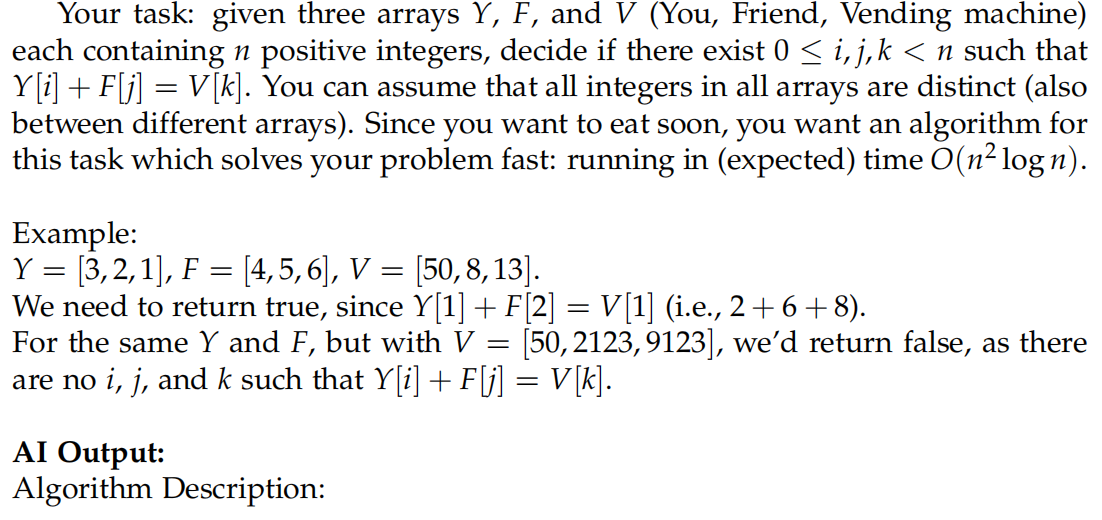
Question: Your task: given three arrays Y , F , and V ( You , Friend, Vending machine ) each containing n positive integers, decide if
Your task: given three arrays and You Friend, Vending machine
each containing positive integers, decide if there exist such that
You can assume that all integers all arrays are distinct
between different arrays Since you want eat soon, you want algorithm for
this task which solves your problem fast: running time
Example:
need return true, since
For the same and but with we'd return false, there
are and such that
Output:
Algorithm Description: Hash Map Initialization: Start by creating a hash map mapv that maps
each price in array V to its index. This allows us to quickly lookup
whether a specific price exists in V
Iterate Over Pairs:
Use two nested loops to iterate over all pairs where is an
index in array Y and j is an index in array F
For each pair calculate the sum 'sum
Binary Search for Matching Price:
For each calculated sum 'sum', check if 'sum' exists in 'mapv
If 'sum' exists, retrieve its index from 'mapv
Check Validity: Ensure that the retrieved index from 'mapv is different
from and to satisfy the condition that you and your friend are both
contributing at least one coin.
Return Result:
If a valid index k is found that satisfies the conditions, return 'true'.
If no such triplet is found after checking all pairs, return
'false'.
Correctness Proof:
Hash Map Usage: By using a hash map for we achieve average
time complexity for lookups, ensuring efficiency in checking whether a
sum exists.
Binary Search: The binary search operation using 'lowerbound' or sim
ilar for finding the index in V ensures that each lookup operation is
efficient within the nested loop structure.
Time Complexity Analysis:
Hash Map Construction: Building 'mapv takes time.
Nested Loops: There are pairs to consider.
Binary Search: Each binary search operation within the nested loop is
Therefore, the overall time complexity is dominated by the nested
loops and the binary search operations.
Your task: To analyse the above response consider each of the following ques
tions and briefly explain your answer to each.
a Does the AI response answer the question, ie does the algorithm solve
the stated problem and does it run in the required time?
b Is the algorithm described in sufficient detail, ie is all information present
or are any parts unclear or missing?
c Is the correctness argument complete or are there leaps or errors in the
logic?
d Is the running time analysis correct for the provided algorithm?
Step by Step Solution
There are 3 Steps involved in it
1 Expert Approved Answer
Step: 1 Unlock

Question Has Been Solved by an Expert!
Get step-by-step solutions from verified subject matter experts
Step: 2 Unlock
Step: 3 Unlock
 Study Help