







Question: Your task is to create a public, concrete class named MyDoublyLinkedList that extends MyAbstractSequentialList and implements Cloneable: public class MyDoublyLinkedListBased on Exercise 2 4 .
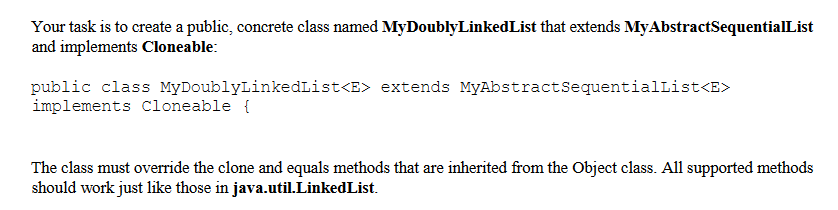
Your task is to create a public, concrete class named MyDoublyLinkedList that extends MyAbstractSequentialList
and implements Cloneable:
public class MyDoublyLinkedListBased on Exercise Implement a doublylinked list:
Download the following files from the assignment page on Canvas
MyDoublyLinkedList.java this is the file that you will modify to include the additional methods
MyList.java
MyAbstractList.java
MyAbstractSequentialList.java
TestMyDoublyLinkedList.java
Your task is to create a public, concrete class named MyDoublyLinkedList that extends MyAbstractSequentialList
and implements Cloneable:
public class MyDoublyLinkedList extends MyAbstractSequentialList
implements Cloneable
The class must override the clone and equals methods that are inherited from the Object class. All supported methods
should work just like those in java.util.LinkedList.
Tip: It is not necessary to override the equals method in MyDoublyLinkedList in order to write the contains, indexOf,
and lastIndexOf methods. The equals method that you will call in those methods is the one provided by the elements
of the list, not the equals method provided by the list class.
Tip : You need to make sure that you understand how the ListIterator is expected to work for implementing
MyAbstractSequentialList. The following is description of ListIterator from the Java Docs. Specifically, you have
to note how the remove and set methods work. Therefore,
If you have invoked next and then call the remove it will delete the node that is the previous of current.
If you have invoked previous and then call remove it will delete the node that is current.
If you have invoked next and then call set it will set the node that is the previous of current.
If you have invoked previous and then call set it will set the node that is the is current.
By default, you cannot call remove or set before invoking next or previous
After you have called add or remove once, you cannot call remove or set before invoking next or
previous again.
Tip : In the iterator's remove method you will probably switch based on the value of iterState., which indicates if a
node can be deleted, cannot be deleted, and if the previous node can be deleted or not.
If the value of iterState is CANREMOVEPREV, consider whether you need to update indexOfNext. Hint:
The index of the next element will be changed by the deletion.
If the value of iterState is CANREMOVECURRENT, consider whether you need to update current. Hint:
You don't want current to point to a node that is no longer in the list.
Step by Step Solution
There are 3 Steps involved in it
1 Expert Approved Answer
Step: 1 Unlock

Question Has Been Solved by an Expert!
Get step-by-step solutions from verified subject matter experts
Step: 2 Unlock
Step: 3 Unlock
 Study Help