







Question: Your task is to design algorithms to solve the following problems. For full credit, your algorithm must run in logarithmic time. Given a number n
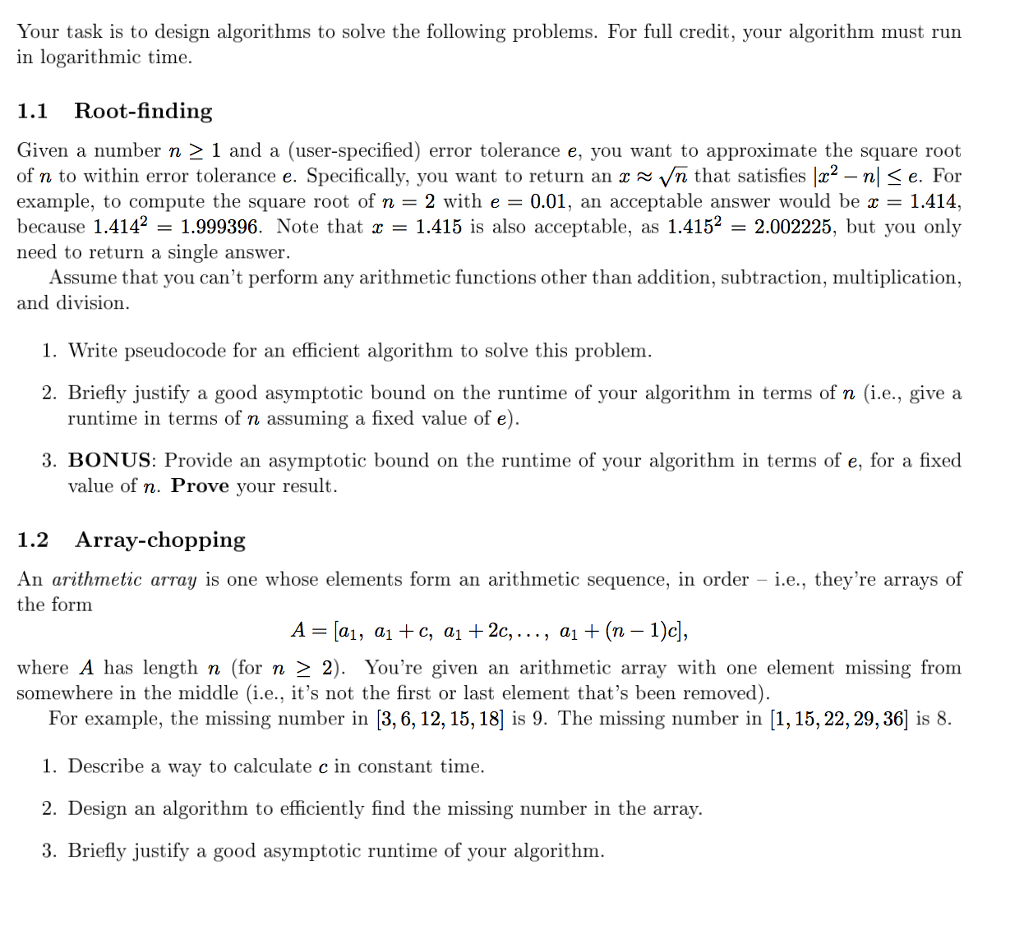
Your task is to design algorithms to solve the following problems. For full credit, your algorithm must run in logarithmic time. Given a number n greaterthanorequalto 1 and a (user-specified) error tolerance e, you want to approximate the squareroot of n to within error tolerance e. Specifically, you want to return an x = Squareroot n that satisfies |x^2 - n| greaterthanorequalto e. For example, to compute the squareroot of n = 2 with e = 0.01, an acceptable answer would be x = 1.414, because 1.414^2 = 1.999396. Note that x = 1.415 is also acceptable, as 1.415^2 = 2.002225, but you only need to return a single answer. Assume that you can't perform any arithmetic functions other than addition, subtraction, multiplication, and division. Write pseudocode for an efficient algorithm to solve this problem. Briefly justify a good asymptotic bound on the runtime of your algorithm in terms of n (i.e., give a runtime in terms of n assuming a fixed value of e). BONUS: Provide an asymptotic bound on the runtime of your algorithm in terms of e, for a fixed value of n. Prove your result. An arithmetic array is one whose elements form an arithmetic sequence, in order - i.e., they're arrays of the form A = [a_1, a_1 + c, a_1 + 2c, ..., a_1 + (n - 1)c], where A has length n (for n greaterthanorequalto 2). You're given an arithmetic array with one element missing from somewhere in the middle (i.e., it's not the first or last element that's been removed). For example, the missing number in [3, 6, 12, 15, 18] is 9. The missing number in [1, 15, 22, 29, 36] is 8. Describe a way to calculate c in constant time. Design an algorithm to efficiently find the missing number in the array. Briefly justify a good asymptotic runtime of your algorithm
Step by Step Solution
There are 3 Steps involved in it

Get step-by-step solutions from verified subject matter experts
 Study Help