







Question: Your Task You will be required to present three recommendations to address the hospitality organization's specific situation and build a business case for sustainability
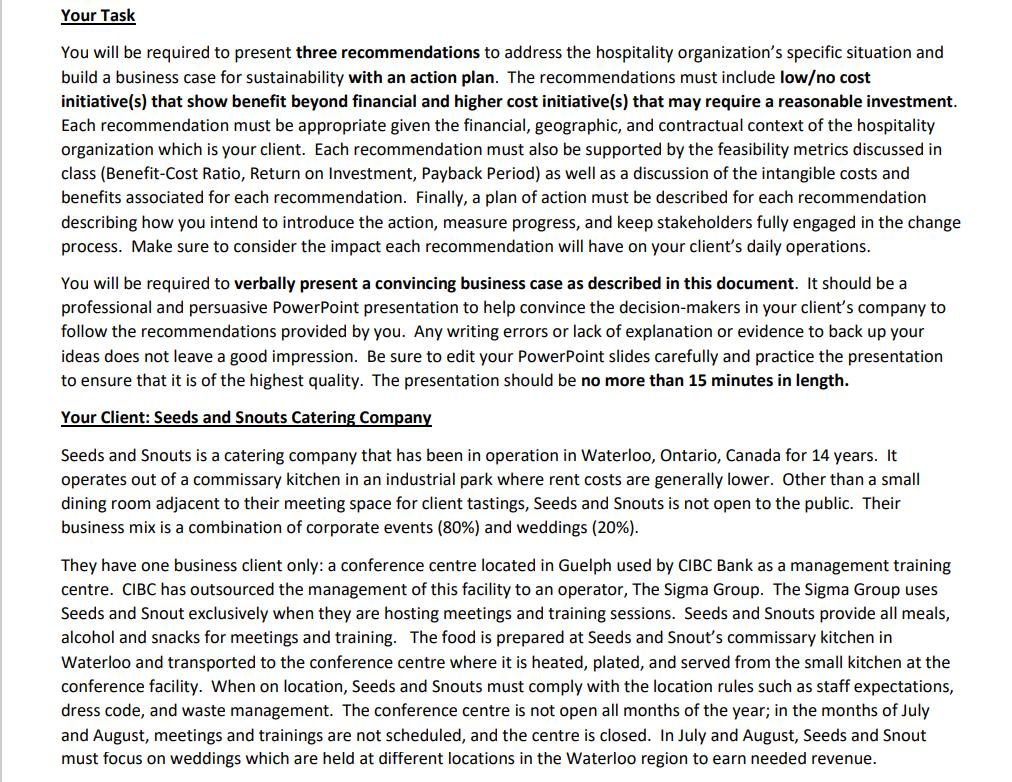
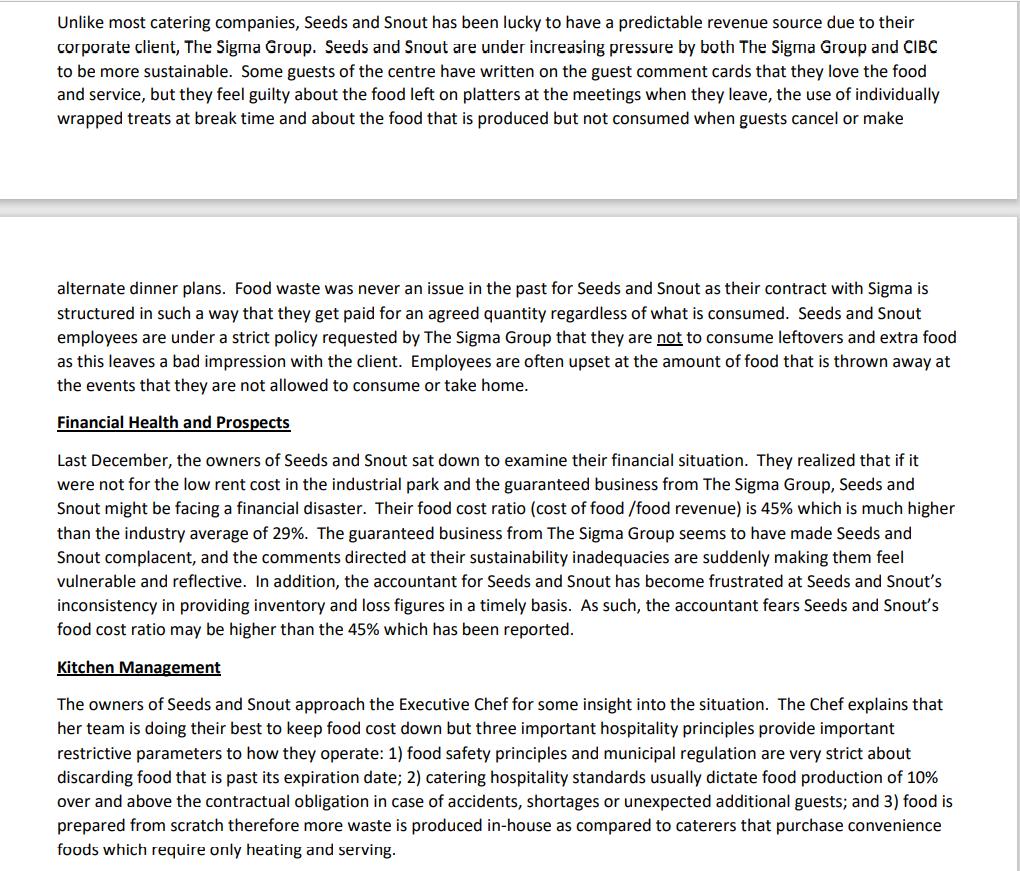
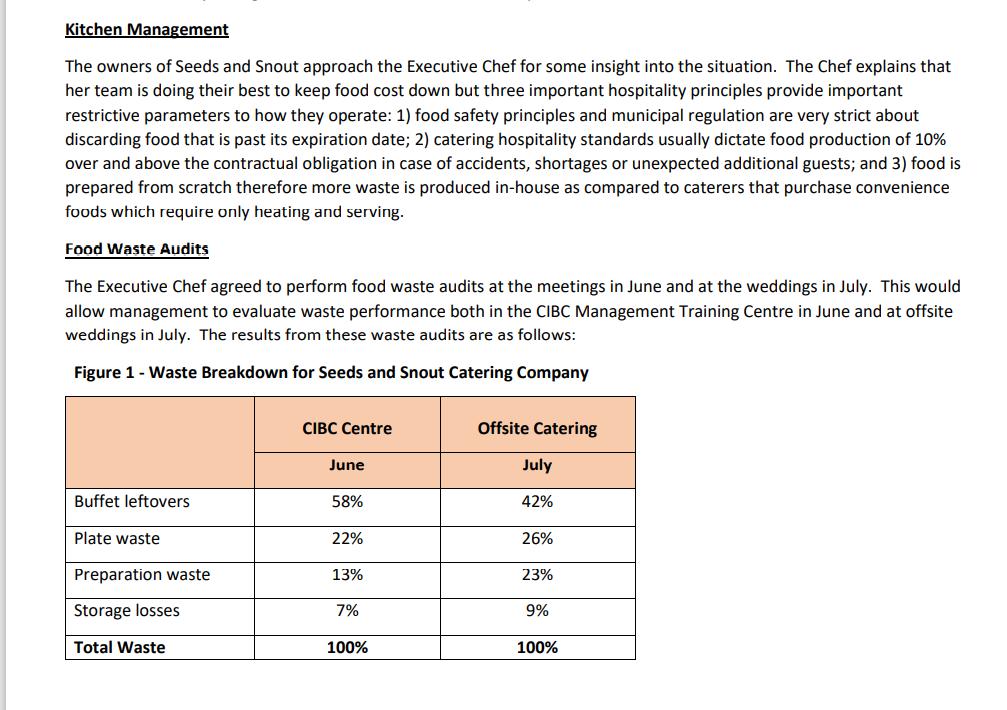
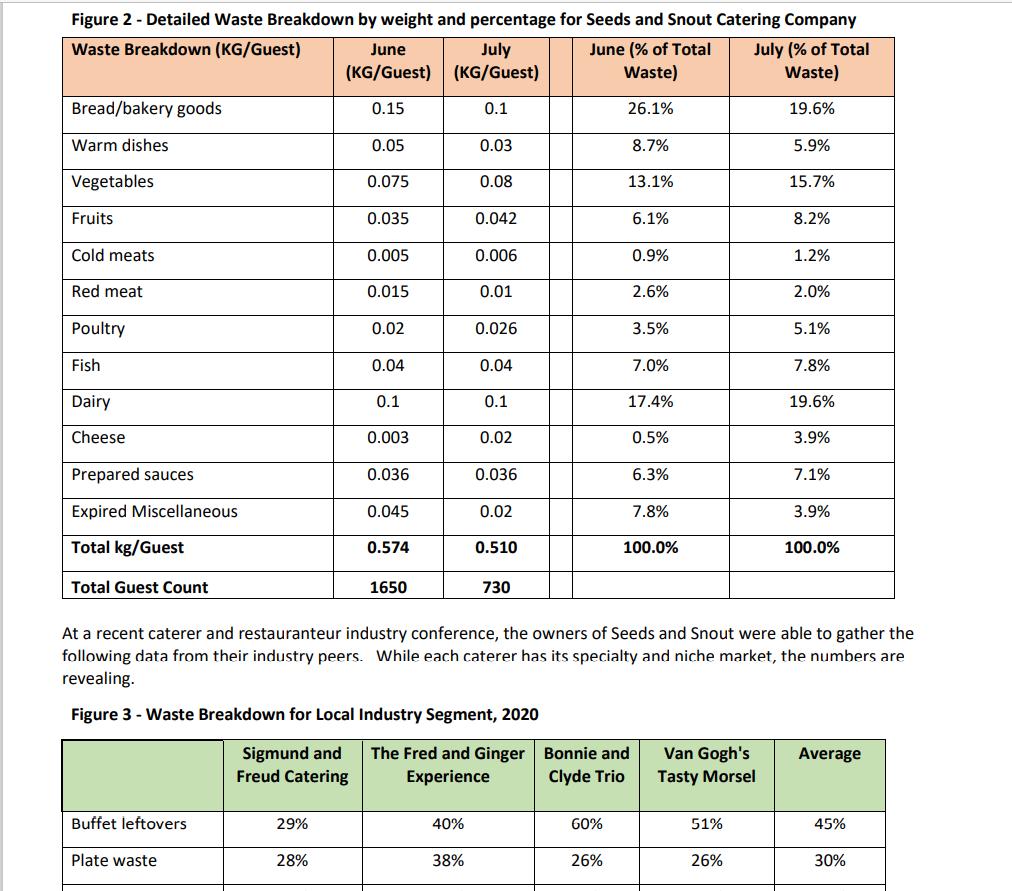
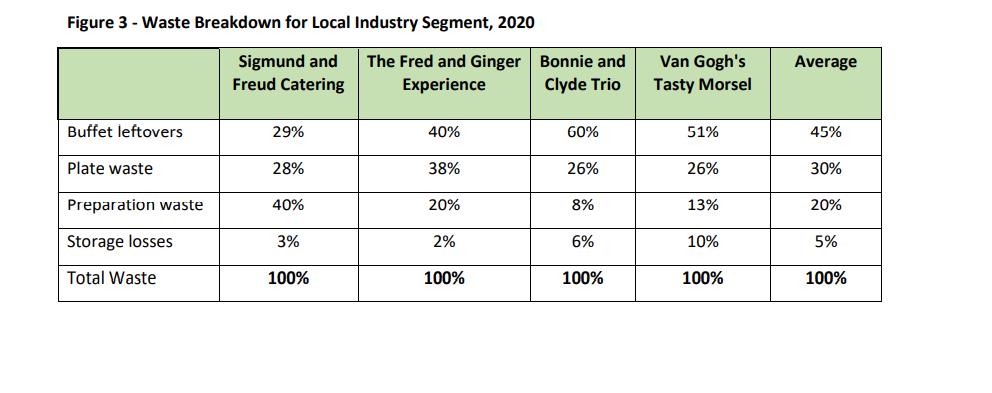
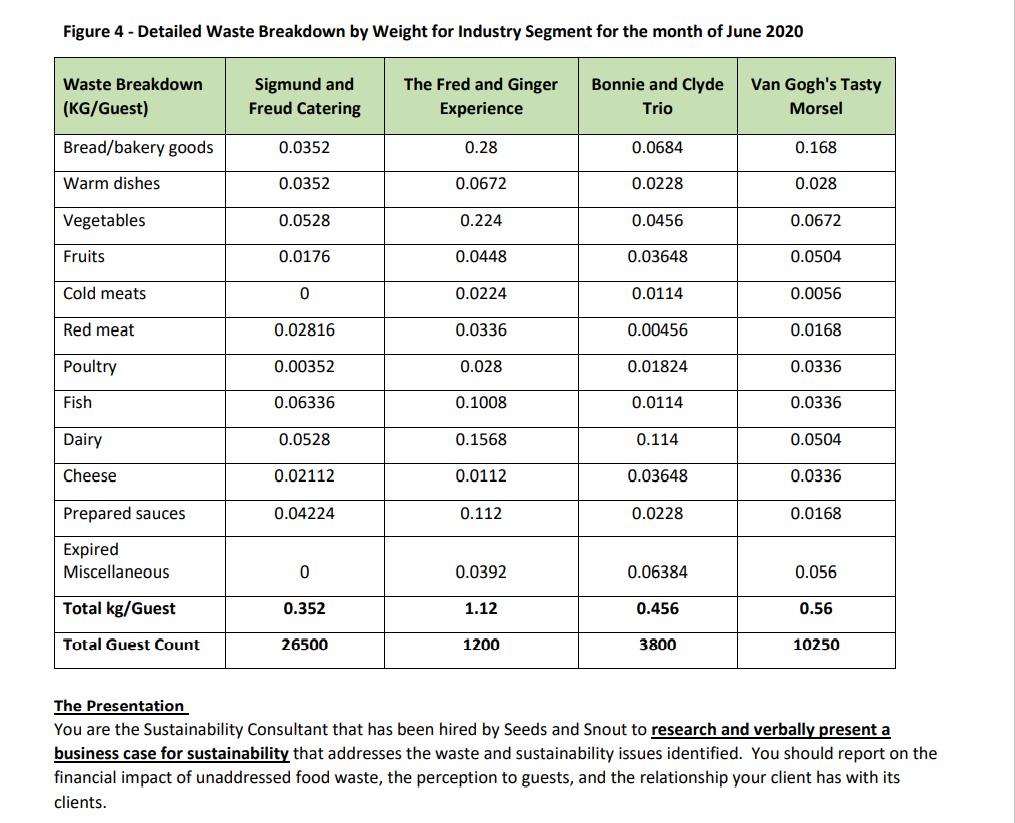
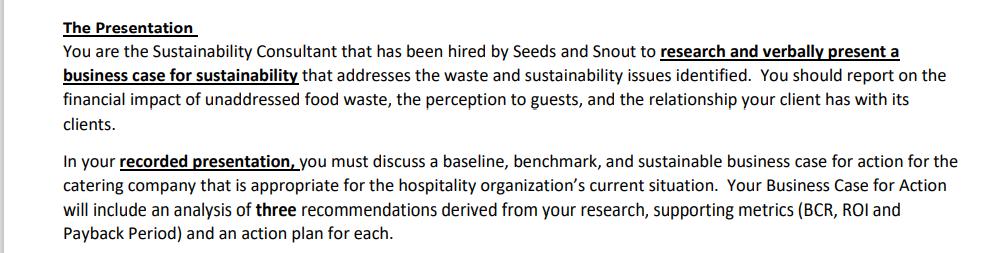
Your Task You will be required to present three recommendations to address the hospitality organization's specific situation and build a business case for sustainability with an action plan. The recommendations must include low/no cost initiative(s) that show benefit beyond financial and higher cost initiative(s) that may require a reasonable investment. Each recommendation must be appropriate given the financial, geographic, and contractual context of the hospitality organization which is your client. Each recommendation must also be supported by the feasibility metrics discussed in class (Benefit-Cost Ratio, Return on Investment, Payback Period) as well as a discussion of the intangible costs and benefits associated for each recommendation. Finally, a plan of action must be described for each recommendation describing how you intend to introduce the action, measure progress, and keep stakeholders fully engaged in the change process. Make sure to consider the impact each recommendation will have on your client's daily operations. You will be required to verbally present a convincing business case as described in this document. It should be a professional and persuasive PowerPoint presentation to help convince the decision-makers in your client's company to follow the recommendations provided by you. Any writing errors or lack of explanation or evidence to back up your ideas does not leave a good impression. Be sure to edit your PowerPoint slides carefully and practice the presentation to ensure that it is of the highest quality. The presentation should be no more than 15 minutes in length. Your Client: Seeds and Snouts Catering Company Seeds and Snouts is a catering company that has been in operation in Waterloo, Ontario, Canada for 14 years. It operates out of a commissary kitchen in an industrial park where rent costs are generally lower. Other than a small dining room adjacent to their meeting space for client tastings, Seeds and Snouts is not open to the public. Their business mix is a combination of corporate events (80%) and weddings (20%). They have one business client only: a conference centre located in Guelph used by CIBC Bank as a management training centre. CIBC has outsourced the management of this facility to an operator, The Sigma Group. The Sigma Group uses Seeds and Snout exclusively when they are hosting meetings and training sessions. Seeds and Snouts provide all meals, alcohol and snacks for meetings and training. The food is prepared at Seeds and Snout's commissary kitchen in Waterloo and transported to the conference centre where it is heated, plated, and served from the small kitchen at the conference facility. When on location, Seeds and Snouts must comply with the location rules such as staff expectations, dress code, and waste management. The conference centre is not open all months of the year; in the months of July and August, meetings and trainings are not scheduled, and the centre is closed. In July and August, Seeds and Snout must focus on weddings which are held at different locations in the Waterloo region to earn needed revenue. Unlike most catering companies, Seeds and Snout has been lucky to have a predictable revenue source due to their corporate client, The Sigma Group. Seeds and Snout are under increasing pressure by both The Sigma Group and CIBC to be more sustainable. Some guests of the centre have written on the guest comment cards that they love the food and service, but they feel guilty about the food left on platters at the meetings when they leave, the use of individually wrapped treats at break time and about the food that is produced but not consumed when guests cancel or make alternate dinner plans. Food waste was never an issue in the past for Seeds and Snout as their contract with Sigma is structured in such a way that they get paid for an agreed quantity regardless of what is consumed. Seeds and Snout employees are under a strict policy requested by The Sigma Group that they are not to consume leftovers and extra food as this leaves a bad impression with the client. Employees are often upset at the amount of food that is thrown away at the events that they are not allowed to consume or take home. Financial Health and Prospects Last December, the owners of Seeds and Snout sat down to examine their financial situation. They realized that if it were not for the low rent cost in the industrial park and the guaranteed business from The Sigma Group, Seeds and Snout might be facing a financial disaster. Their food cost ratio (cost of food /food revenue) is 45% which is much higher than the industry average of 29%. The guaranteed business from The Sigma Group seems to have made Seeds and Snout complacent, and the comments directed at their sustainability inadequacies are suddenly making them feel vulnerable and reflective. In addition, the accountant for Seeds and Snout has become frustrated at Seeds and Snout's inconsistency in providing inventory and loss figures in a timely basis. As such, the accountant fears Seeds and Snout's food cost ratio may be higher than the 45% which has been reported. Kitchen Management The owners of Seeds and Snout approach the Executive Chef for some insight into the situation. The Chef explains that her team is doing their best to keep food cost down but three important hospitality principles provide important restrictive parameters to how they operate: 1) food safety principles and municipal regulation are very strict about discarding food that is past its expiration date; 2) catering hospitality standards usually dictate food production of 10% over and above the contractual obligation in case of accidents, shortages or unexpected additional guests; and 3) food is prepared from scratch therefore more waste is produced in-house as compared to caterers that purchase convenience foods which require only heating and serving. Kitchen Management The owners of Seeds and Snout approach the Executive Chef for some insight into the situation. The Chef explains that her team is doing their best to keep food cost down but three important hospitality principles provide important restrictive parameters to how they operate: 1) food safety principles and municipal regulation are very strict about discarding food that is past its expiration date; 2) catering hospitality standards usually dictate food production of 10% over and above the contractual obligation in case of accidents, shortages or unexpected additional guests; and 3) food is prepared from scratch therefore more waste is produced in-house as compared to caterers that purchase convenience foods which require only heating and serving. Food Waste Audits The Executive Chef agreed to perform food waste audits at the meetings in June and at the weddings in July. This would allow management to evaluate waste performance both in the CIBC Management Training Centre in June and at offsite weddings in July. The results from these waste audits are as follows: Figure 1 - Waste Breakdown for Seeds and Snout Catering Company Buffet leftovers Plate waste Preparation waste Storage losses Total Waste CIBC Centre June 58% 22% 13% 7% 100% Offsite Catering July 42% 26% 23% 9% 100% Figure 2 - Detailed Waste Breakdown by weight and percentage for Seeds and Snout Catering Company Waste Breakdown (KG/Guest) July (% of Total June (% of Total Waste) Waste) 26.1% Bread/bakery goods Warm dishes Vegetables Fruits Cold meats Red meat Poultry Fish Dairy Cheese Prepared sauces Expired Miscellaneous Total kg/Guest Total Guest Count Buffet leftovers Plate waste 29% June (KG/Guest) 0.15 28% 0.05 0.075 0.035 0.005 0.015 0.02 0.04 0.1 0.003 0.036 0.045 0.574 1650 July (KG/Guest) 0.1 0.03 0.08 40% 0.042 0.006 38% 0.01 0.026 0.04 0.1 0.02 0.036 0.02 0.510 730 The Fred and Ginger Experience 8.7% 13.1% 60% 26% 6.1% Bonnie and Clyde Trio 0.9% 2.6% 3.5% 7.0% 17.4% 0.5% 6.3% 7.8% 100.0% Van Gogh's Tasty Morsel At a recent caterer and restauranteur industry conference, the owners of Seeds and Snout were able to gather the following data from their industry peers. While each caterer has its specialty and niche market, the numbers are revealing. Figure 3 - Waste Breakdown for Local Industry Segment, 2020 Sigmund and Freud Catering 51% 19.6% 26% 5.9% 15.7% 8.2% 1.2% 2.0% 5.1% 7.8% 19.6% 3.9% 7.1% 3.9% 100.0% Average 45% 30% Figure 3 - Waste Breakdown for Local Industry Segment, 2020 Sigmund and Freud Catering The Fred and Ginger Experience Buffet leftovers Plate waste Preparation waste Storage losses Total Waste 29% 28% 40% 3% 100% 40% 38% 20% 2% 100% Bonnie and Clyde Trio 60% 26% 8% 6% 100% Van Gogh's Tasty Morsel 51% 26% 13% 10% 100% Average 45% 30% 20% 5% 100% Figure 4 - Detailed Waste Breakdown by Weight for Industry Segment for the month of June 2020 Waste Breakdown (KG/Guest) Bread/bakery goods Warm dishes Vegetables Fruits Cold meats Red meat Poultry Fish Dairy Cheese Prepared sauces Expired Miscellaneous Total kg/Guest Total Guest Count Sigmund and Freud Catering 0.0352 0.0352 0.0528 0.0176 0 0.02816 0.00352 0.06336 0.0528 0.02112 0.04224 0 0.352 26500 The Fred and Ginger Bonnie and Clyde Van Gogh's Tasty Experience Trio Morsel 0.28 0.0672 0.224 0.0448 0.0224 0.0336 0.028 0.1008 0.1568 0.0112 0.112 0.0392 1.12 1200 0.0684 0.0228 0.0456 0.03648 0.0114 0.00456 0.01824 0.0114 0.114 0.03648 0.0228 0.06384 0.456 3800 0.168 0.028 0.0672 0.0504 0.0056 0.0168 0.0336 0.0336 0.0504 0.0336 0.0168 0.056 0.56 10250 The Presentation You are the Sustainability Consultant that has been hired by Seeds and Snout to research and verbally present a business case for sustainability that addresses the waste and sustainability issues identified. You should report on the financial impact of unaddressed food waste, the perception to guests, and the relationship your client has with its clients. The Presentation You are the Sustainability Consultant that has been hired by Seeds and Snout to research and verbally present a business case for sustainability that addresses the waste and sustainability issues identified. You should report on the financial impact of unaddressed food waste, the perception to guests, and the relationship your client has with its clients. In your recorded presentation, you must discuss a baseline, benchmark, and sustainable business case for action for the catering company that is appropriate for the hospitality organization's current situation. Your Business Case for Action will include an analysis of three recommendations derived from your research, supporting metrics (BCR, ROI and Payback Period) and an action plan for each.
Step by Step Solution
3.42 Rating (155 Votes )
There are 3 Steps involved in it
AIM TO BE LOYAL Learn to be adaptive and flexible to the needs of the customer regardless of how unimportant they may seem Make sure your visitor has every good reason to return By doing this you will ... View full answer

Get step-by-step solutions from verified subject matter experts
 Study Help