







Question: Your work should be based on the following DES Triple in Hexadecimal notation (for conversion between Hexadecimal notation and Binary notation, refer to Problem

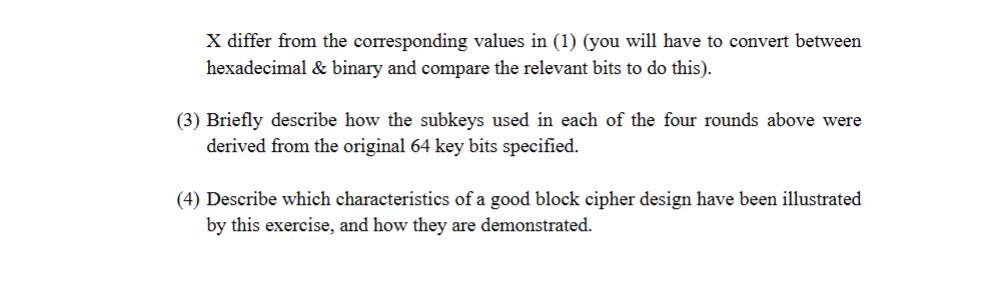
Your work should be based on the following DES Triple in Hexadecimal notation (for conversion between Hexadecimal notation and Binary notation, refer to Problem 3.11 in page 83 of the textbook): 9f4f190e284c81cf 2e8c0bba428c5016 cce688d45aa07b0f (Key) (Plaintext) (Ciphertext) For this part, you will use the key and plaintext values from this triple in the DES Calculator. With this triple, you are asked to do the following tasks: (1) Encrypt the plaintext using the key given in your triple, with tracing of the round values. Note how the bits in X (the left and right halves of the data) change from round to round. What is the value of your X at the start of round 5? (2) Change DES bit 12 of the PLAINTEXT in your triple (i.e., change the 0 to 1, or 1 to 0 as appropriate), assuming DES bit numbering from left (MSB) bit 1 to right (LSB) bit 64. Encrypt this new plaintext value using the DES Calculator. Using the trace output, after each of the first four rounds list in a table how many bits of X differ from the corresponding values in (1) (you will have to convert between hexadecimal & binary and compare the relevant bits to do this). (3) Briefly describe how the subkeys used in each of the four rounds above were derived from the original 64 key bits specified. (4) Describe which characteristics of a good block cipher design have been illustrated by this exercise, and how they are demonstrated.
Step by Step Solution
There are 3 Steps involved in it
Lets tackle each part of your task step by step 1 Encrypting the plaintext using the given key involves running through the DES algorithm with the spe... View full answer

Get step-by-step solutions from verified subject matter experts
 Study Help