Question: Your Worldview & Complex Problems Project should include the elements covered in this course - evidence of a biblical Christian worldview, consideration of the modes
Your Worldview & Complex Problems Project should include the elements covered in this course - evidence of a biblical Christian worldview, consideration of the modes of inquiry as they relate to your problem, and consideration of your audience in the proposed solution.
Worldview & Complex Problems
Course:CORE 3113 - Worldview and Complex Problems
Submission Title:Christian Perspectives on the Implications of Automation for the Job Market
1. Selected Topic
Topic Chosen:Christian Perspectives on the Implications of Automation for the Job Market
???A definition of the problem you are attempting to solve (a statement of the problem)
???summary of your audience (who are you aiming to reach? What are their characteristics?)
???A 360-degree review of the topic/complex problem using the tools in SEU's Modes of Inquiry. For each mode of inquiry, define what has been offered by other researchers and what left remains uncovered / unanswered as an approach to solving the problem.
???proposed solution to the problem.
Your response should be well-structured, coherent, Make sure to provide clear explanations and examples to support your points. The purpose of this assignment is to assess your ability to use the Modes of Inquiry as a tool for understanding (and solving) complex problems, their characteristics, how they have been addressed, and what remains unconsidered.
Inclusion of material from and page references to the textbook reading.Quality of ideas, logic, support for points, and grasp of the course materials. exhibit college-level writing, and include specific references and page numbers of those references from the text.
Class Course is CORE 3113 WORLDVIEW AND COMPLEX PROBLEMS
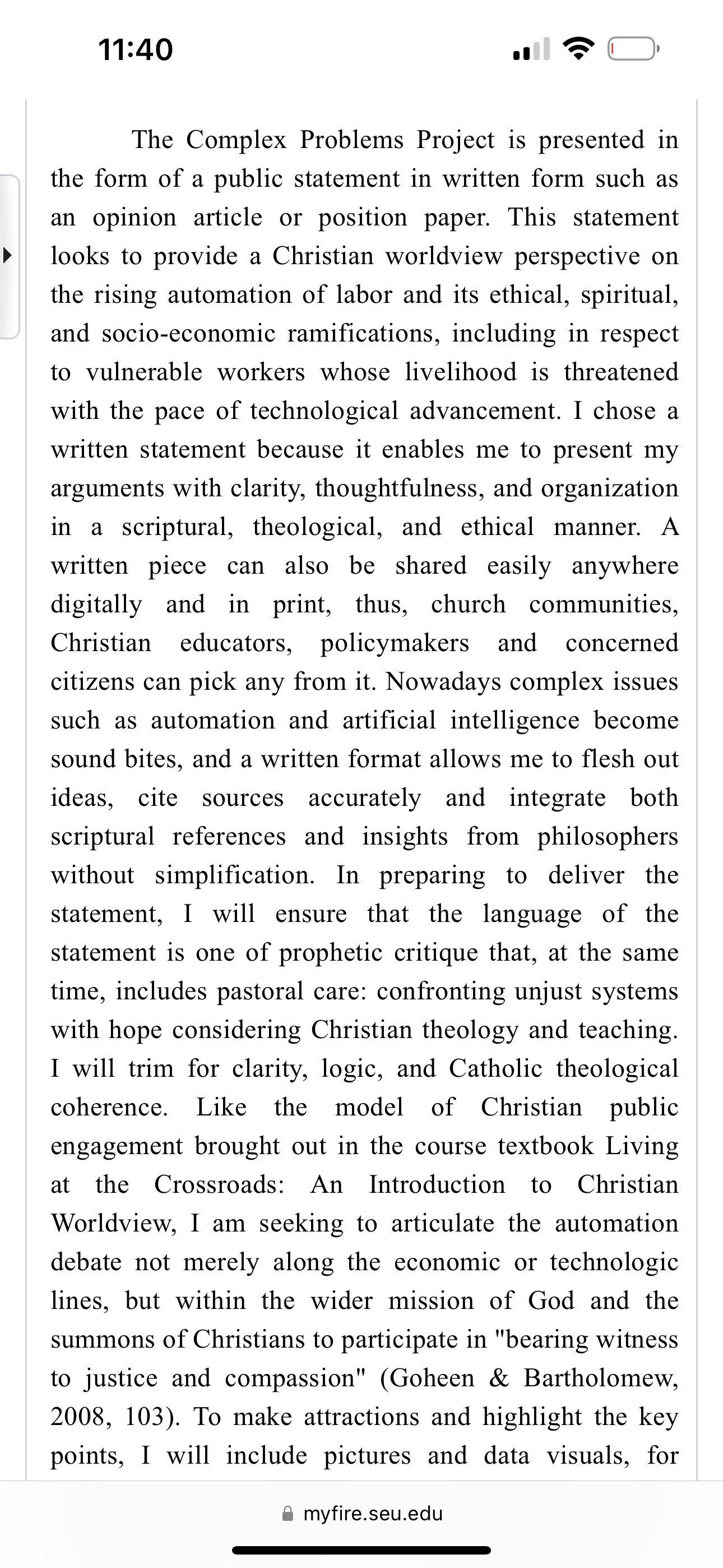
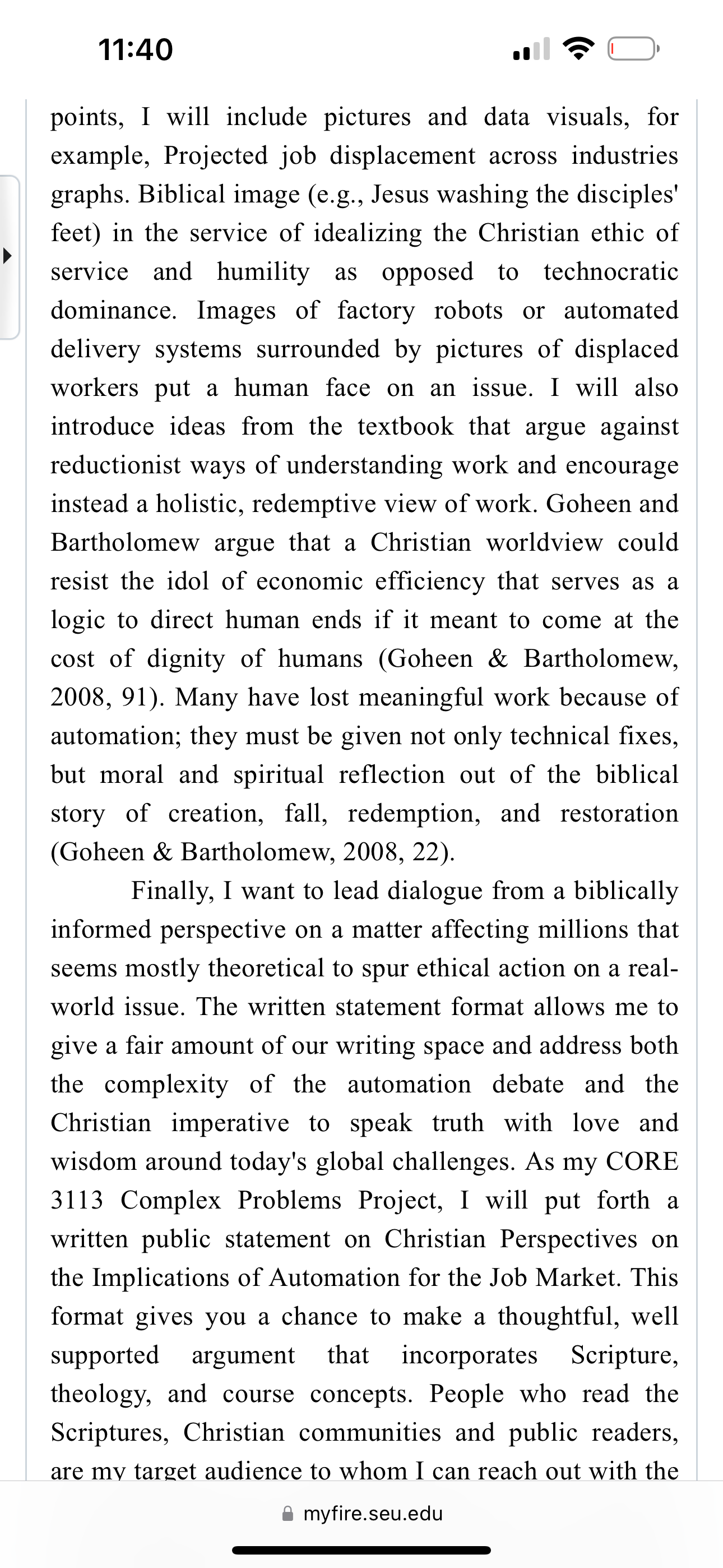
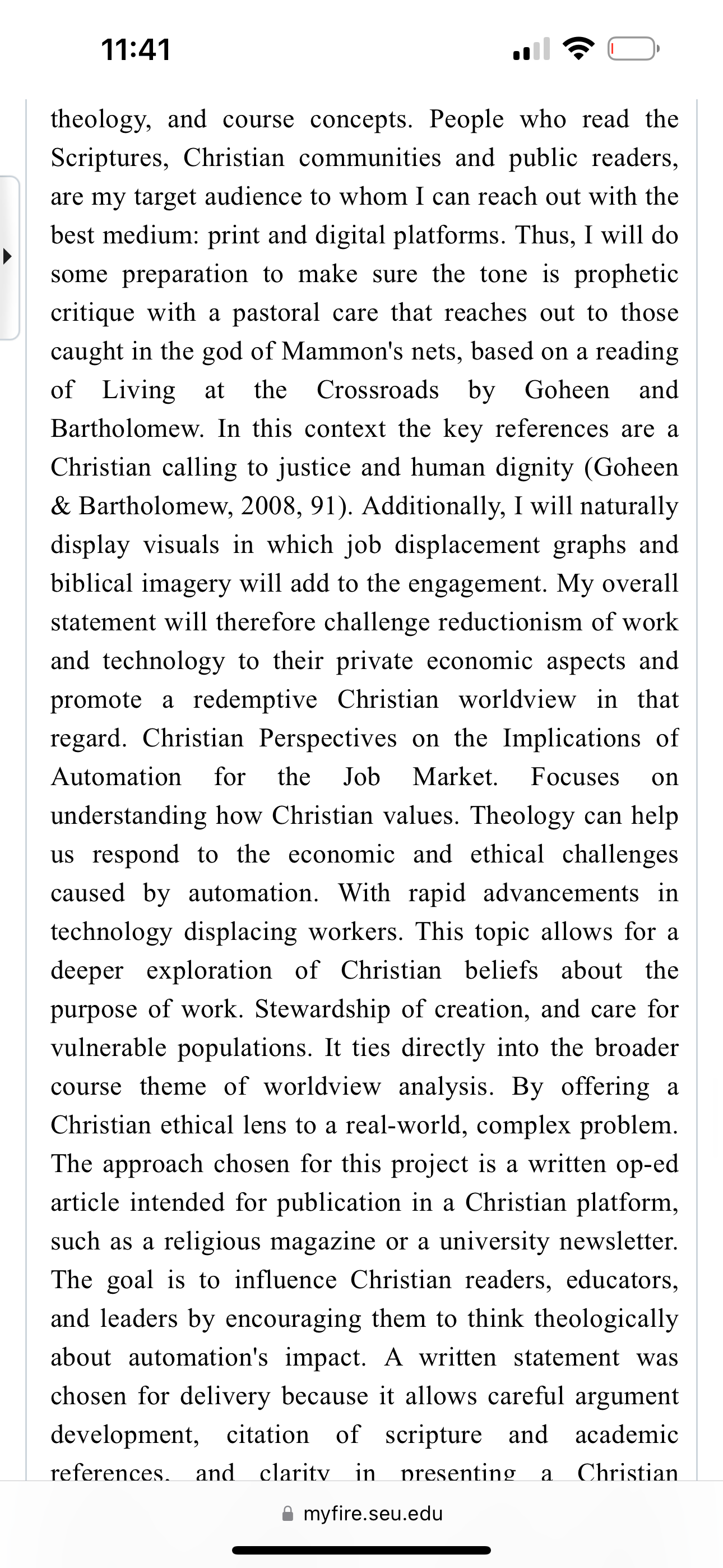
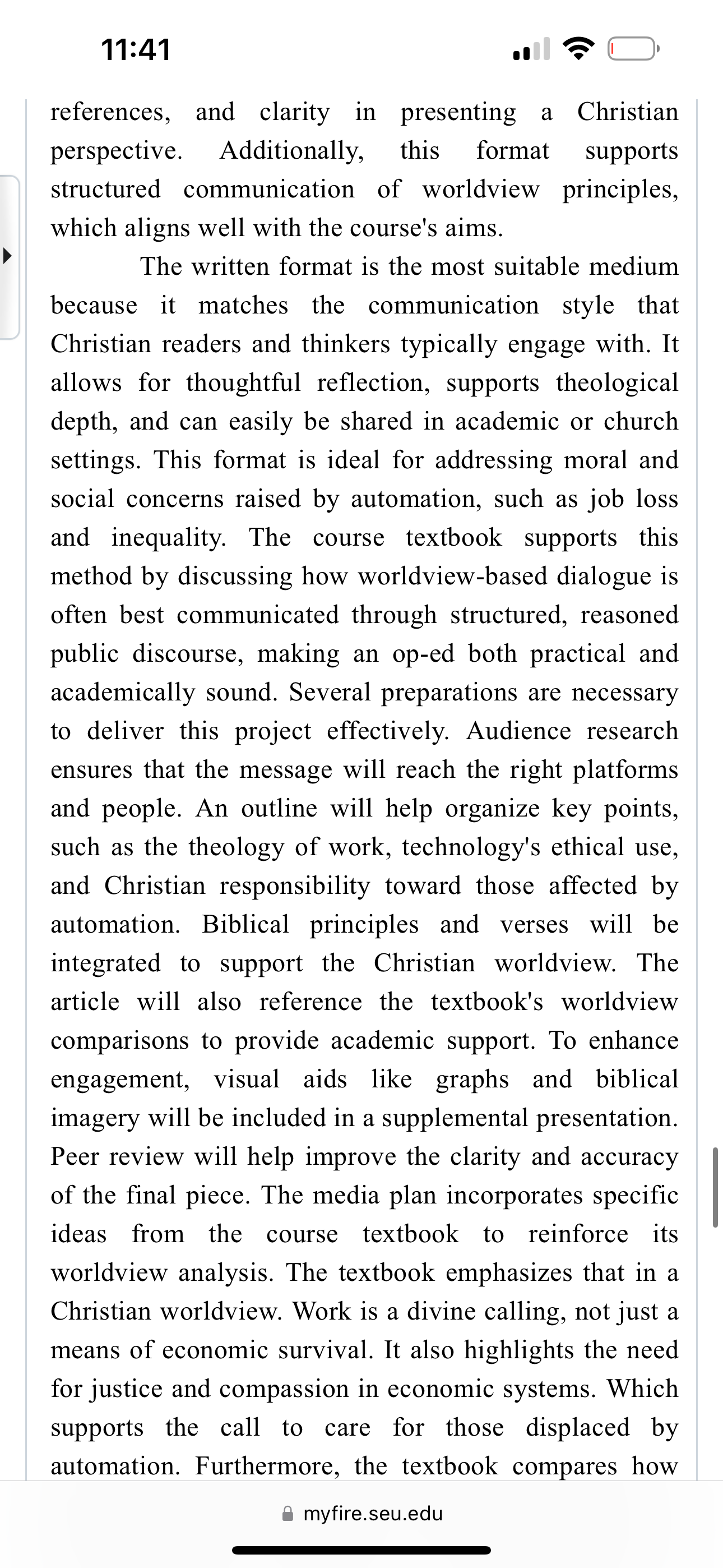
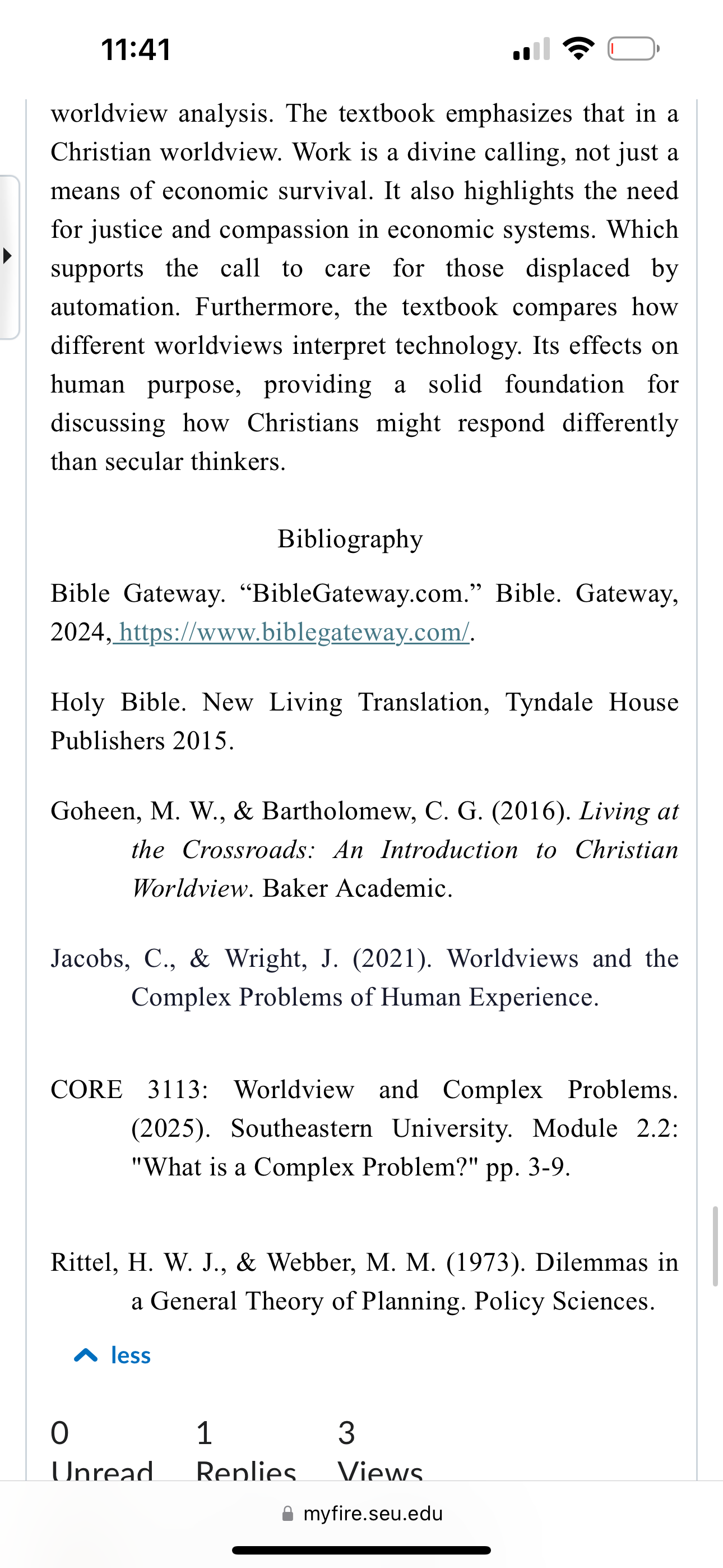
11:40 wl eo The Complex Problems Project is presented in the form of a public statement in written form such as an opinion article or position paper. This statement looks to provide a Christian worldview perspective on the rising automation of labor and its ethical, spiritual, and socio-economic ramifications, including in respect to vulnerable workers whose livelihood is threatened with the pace of technological advancement. I chose a written statement because it enables me to present my arguments with clarity, thoughtfulness, and organization in a scriptural, theological, and ethical manner. A written piece can also be shared easily anywhere digitally and in print, thus, church communities, Christian educators, policymakers and concerned citizens can pick any from it. Nowadays complex issues such as automation and artificial intelligence become sound bites, and a written format allows me to flesh out ideas, cite sources accurately and integrate both scriptural references and insights from philosophers without simplification. In preparing to deliver the statement, I will ensure that the language of the statement is one of prophetic critique that, at the same time, includes pastoral care: confronting unjust systems with hope considering Christian theology and teaching. I will trim for clarity, logic, and Catholic theological coherence. Like the model of Christian public engagement brought out in the course textbook Living at the Crossroads: An Introduction to Christian Worldview, I am seeking to articulate the automation debate not merely along the economic or technologic lines, but within the wider mission of God and the summons of Christians to participate in "bearing witness to justice and compassion" (Goheen & Bartholomew, 2008, 103). To make attractions and highlight the key points, I will include pictures and data visuals, for @ myfire.seu.edu 11:40 wl eo points, I will include pictures and data visuals, for example, Projected job displacement across industries graphs. Biblical image (e.g., Jesus washing the disciples' feet) in the service of idealizing the Christian ethic of service and humility as opposed to technocratic dominance. Images of factory robots or automated delivery systems surrounded by pictures of displaced workers put a human face on an issue. I will also introduce ideas from the textbook that argue against reductionist ways of understanding work and encourage instead a holistic, redemptive view of work. Goheen and Bartholomew argue that a Christian worldview could resist the idol of economic efficiency that serves as a logic to direct human ends if it meant to come at the cost of dignity of humans (Goheen & Bartholomew, 2008, 91). Many have lost meaningful work because of automation; they must be given not only technical fixes, but moral and spiritual reflection out of the biblical story of creation, fall, redemption, and restoration (Goheen & Bartholomew, 2008, 22). Finally, I want to lead dialogue from a biblically informed perspective on a matter affecting millions that seems mostly theoretical to spur ethical action on a real- world issue. The written statement format allows me to give a fair amount of our writing space and address both the complexity of the automation debate and the Christian imperative to speak truth with love and wisdom around today's global challenges. As my CORE 3113 Complex Problems Project, I will put forth a written public statement on Christian Perspectives on the Implications of Automation for the Job Market. This format gives you a chance to make a thoughtful, well supported argument that incorporates Scripture, theology, and course concepts. People who read the Scriptures, Christian communities and public readers, are my target audience to whom I can reach out with the @ myfire.seu.edu 11:41 wl So) theology, and course concepts. People who read the Scriptures, Christian communities and public readers, are my target audience to whom I can reach out with the best medium: print and digital platforms. Thus, I will do some preparation to make sure the tone is prophetic critique with a pastoral care that reaches out to those caught in the god of Mammon's nets, based on a reading of Living at the Crossroads by Goheen and Bartholomew. In this context the key references are a Christian calling to justice and human dignity (Goheen & Bartholomew, 2008, 91). Additionally, I will naturally display visuals in which job displacement graphs and biblical imagery will add to the engagement. My overall statement will therefore challenge reductionism of work and technology to their private economic aspects and promote a redemptive Christian worldview in_ that regard. Christian Perspectives on the Implications of Automation for the Job Market. Focuses' on understanding how Christian values. Theology can help us respond to the economic and ethical challenges caused by automation. With rapid advancements in technology displacing workers. This topic allows for a deeper exploration of Christian beliefs about the purpose of work. Stewardship of creation, and care for vulnerable populations. It ties directly into the broader course theme of worldview analysis. By offering a Christian ethical lens to a real-world, complex problem. The approach chosen for this project is a written op-ed article intended for publication in a Christian platform, such as a religious magazine or a university newsletter. The goal is to influence Christian readers, educators, and leaders by encouraging them to think theologically about automation's impact. A written statement was chosen for delivery because it allows careful argument development, citation of scripture and academic references. and claritv in_ nresenting a Christian @ myfire.seu.edu 11:41 wl So) references, and clarity in presenting a Christian perspective. Additionally, this format supports structured communication of worldview principles, which aligns well with the course's aims. The written format is the most suitable medium because it matches the communication style that Christian readers and thinkers typically engage with. It allows for thoughtful reflection, supports theological depth, and can easily be shared in academic or church settings. This format is ideal for addressing moral and social concerns raised by automation, such as job loss and inequality. The course textbook supports this method by discussing how worldview-based dialogue is often best communicated through structured, reasoned public discourse, making an op-ed both practical and academically sound. Several preparations are necessary to deliver this project effectively. Audience research ensures that the message will reach the right platforms and people. An outline will help organize key points, such as the theology of work, technology's ethical use, and Christian responsibility toward those affected by automation. Biblical principles and verses will be integrated to support the Christian worldview. The article will also reference the textbook's worldview comparisons to provide academic support. To enhance engagement, visual aids like graphs and_ biblical imagery will be included in a supplemental presentation. Peer review will help improve the clarity and accuracy of the final piece. The media plan incorporates specific ideas from the course textbook to reinforce its worldview analysis. The textbook emphasizes that in a Christian worldview. Work is a divine calling, not just a means of economic survival. It also highlights the need for justice and compassion in economic systems. Which supports the call to care for those displaced by automation. Furthermore, the textbook compares how @ myfire.seu.edu 11:41 wl So) worldview analysis. The textbook emphasizes that in a Christian worldview. Work is a divine calling, not just a means of economic survival. It also highlights the need for justice and compassion in economic systems. Which supports the call to care for those displaced by automation. Furthermore, the textbook compares how different worldviews interpret technology. Its effects on human purpose, providing a solid foundation for discussing how Christians might respond differently than secular thinkers. Bibliography Bible Gateway. \"BibleGateway.com.\" Bible. Gateway, 2024, https://www.biblegateway.com/. Holy Bible. New Living Translation, Tyndale House Publishers 2015. Goheen, M. W., & Bartholomew, C. G. (2016). Living at the Crossroads: An Introduction to Christian Worldview. Baker Academic. Jacobs, C., & Wright, J. (2021). Worldviews and the Complex Problems of Human Experience. CORE 3113: Worldview and Complex Problems. (2025). Southeastern University. Module 2.2: "What is a Complex Problem?" pp. 3-9. Rittel, H. W. J., & Webber, M. M. (1973). Dilemmas in a General Theory of Planning. Policy Sciences. \"\" less O 1 3 Unread Renlies Views @ myfire.seu.edu
Step by Step Solution
There are 3 Steps involved in it
1 Expert Approved Answer
Step: 1 Unlock
Question Has Been Solved by an Expert!
Get step-by-step solutions from verified subject matter experts
Step: 2 Unlock
Step: 3 Unlock
Students Have Also Explored These Related Accounting Questions!









 Study Help