



Question: Your written component should contain the following sections: 1. Introduction Briefly introduce your issue and analysis 1 2020/2021, Sem 2 2. Issue Review Give an
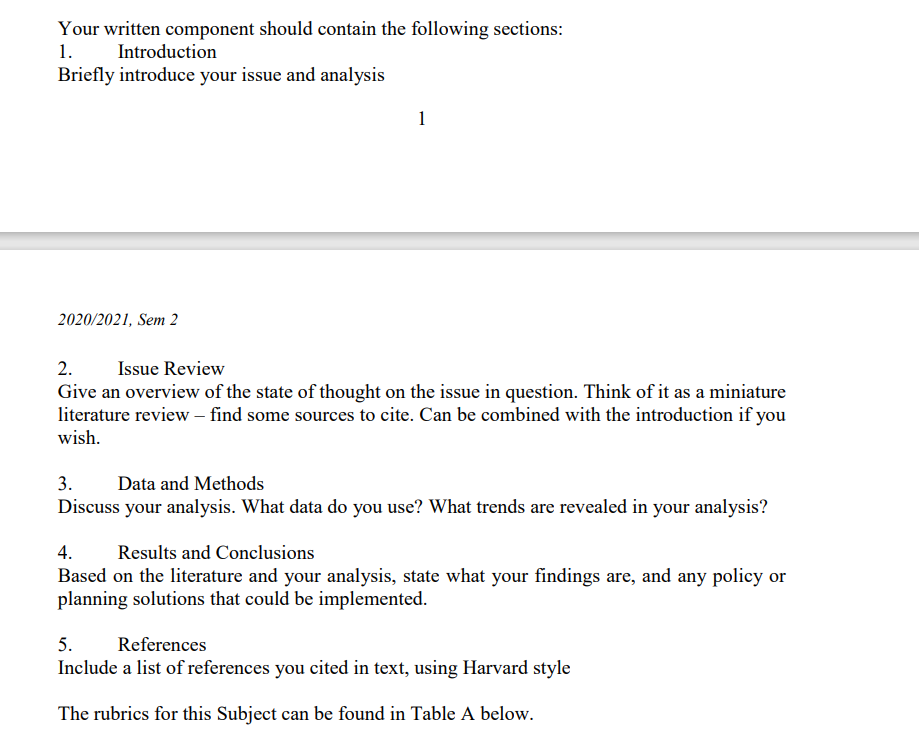
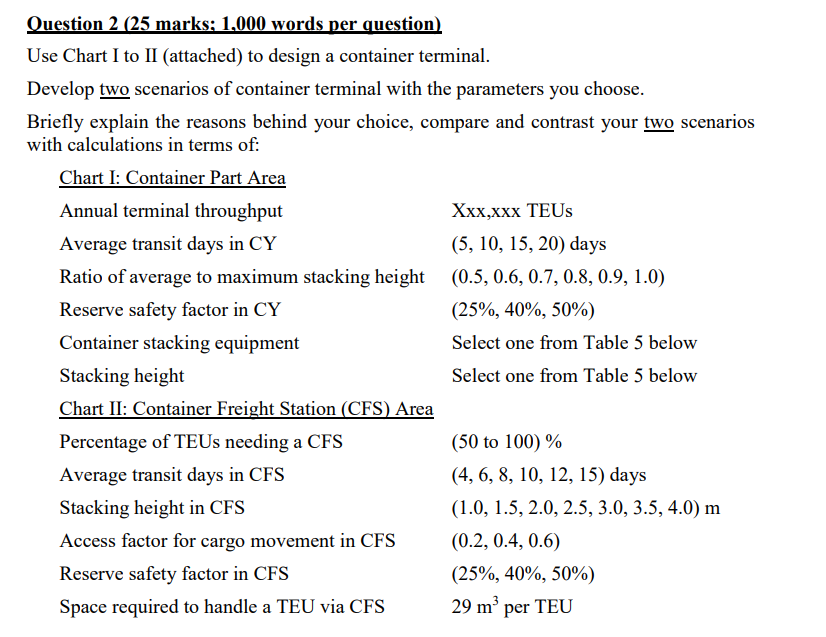
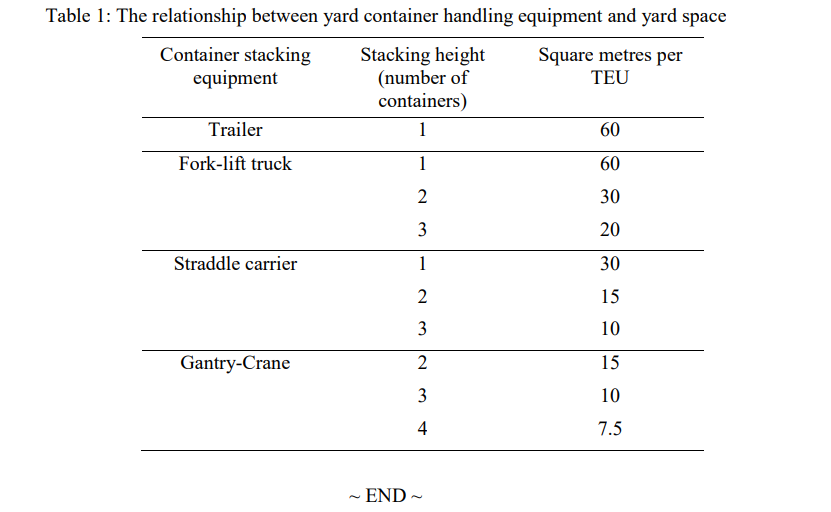
Your written component should contain the following sections: 1. Introduction Briefly introduce your issue and analysis 1 2020/2021, Sem 2 2. Issue Review Give an overview of the state of thought on the issue in question. Think of it as a miniature literature review find some sources to cite. Can be combined with the introduction if you wish. 3. Data and Methods Discuss your analysis. What data do you use? What trends are revealed in your analysis? 4. Results and Conclusions Based on the literature and your analysis, state what your findings are, and any policy or planning solutions that could be implemented. 5. References Include a list of references you cited in text, using Harvard style The rubrics for this Subject can be found in Table A below. Question 2 (25 marks; 1,000 words per question) Use Chart I to II (attached) to design a container terminal. Develop two scenarios of container terminal with the parameters you choose. Briefly explain the reasons behind your choice, compare and contrast your two scenarios with calculations in terms of: Chart I: Container Part Area Annual terminal throughput Xxx.xxx TEUS Average transit days in CY (5, 10, 15, 20) days Ratio of average to maximum stacking height (0.5, 0.6, 0.7, 0.8, 0.9, 1.0) Reserve safety factor in CY (25%, 40%, 50%) Container stacking equipment Select one from Table 5 below Stacking height Select one from Table 5 below Chart II: Container Freight Station (CFS) Area Percentage of TEUs needing a CFS (50 to 100) % Average transit days in CFS (4, 6, 8, 10, 12, 15) days Stacking height in CFS (1.0, 1.5, 2.0, 2.5, 3.0, 3.5, 4.0) m Access factor for cargo movement in CFS (0.2, 0.4, 0.6) Reserve safety factor in CFS (25%, 40%, 50%) Space required to handle a TEU via CFS 29 m per TEU Table 1: The relationship between yard container handling equipment and yard space Container stacking Stacking height Square metres per equipment (number of TEU containers) Trailer 1 60 Fork-lift truck 1 60 30 N 3 20 Straddle carrier 1 30 2 15 10 3 Gantry-Crane 2 15 3 10 4 7.5 -END Your written component should contain the following sections: 1. Introduction Briefly introduce your issue and analysis 1 2020/2021, Sem 2 2. Issue Review Give an overview of the state of thought on the issue in question. Think of it as a miniature literature review find some sources to cite. Can be combined with the introduction if you wish. 3. Data and Methods Discuss your analysis. What data do you use? What trends are revealed in your analysis? 4. Results and Conclusions Based on the literature and your analysis, state what your findings are, and any policy or planning solutions that could be implemented. 5. References Include a list of references you cited in text, using Harvard style The rubrics for this Subject can be found in Table A below. Question 2 (25 marks; 1,000 words per question) Use Chart I to II (attached) to design a container terminal. Develop two scenarios of container terminal with the parameters you choose. Briefly explain the reasons behind your choice, compare and contrast your two scenarios with calculations in terms of: Chart I: Container Part Area Annual terminal throughput Xxx.xxx TEUS Average transit days in CY (5, 10, 15, 20) days Ratio of average to maximum stacking height (0.5, 0.6, 0.7, 0.8, 0.9, 1.0) Reserve safety factor in CY (25%, 40%, 50%) Container stacking equipment Select one from Table 5 below Stacking height Select one from Table 5 below Chart II: Container Freight Station (CFS) Area Percentage of TEUs needing a CFS (50 to 100) % Average transit days in CFS (4, 6, 8, 10, 12, 15) days Stacking height in CFS (1.0, 1.5, 2.0, 2.5, 3.0, 3.5, 4.0) m Access factor for cargo movement in CFS (0.2, 0.4, 0.6) Reserve safety factor in CFS (25%, 40%, 50%) Space required to handle a TEU via CFS 29 m per TEU Table 1: The relationship between yard container handling equipment and yard space Container stacking Stacking height Square metres per equipment (number of TEU containers) Trailer 1 60 Fork-lift truck 1 60 30 N 3 20 Straddle carrier 1 30 2 15 10 3 Gantry-Crane 2 15 3 10 4 7.5 -END
Step by Step Solution
There are 3 Steps involved in it

Get step-by-step solutions from verified subject matter experts