



Question: You're designing a toaster, and the last piece it needs is a spring to pop the toast up when it's done. The one requirement from
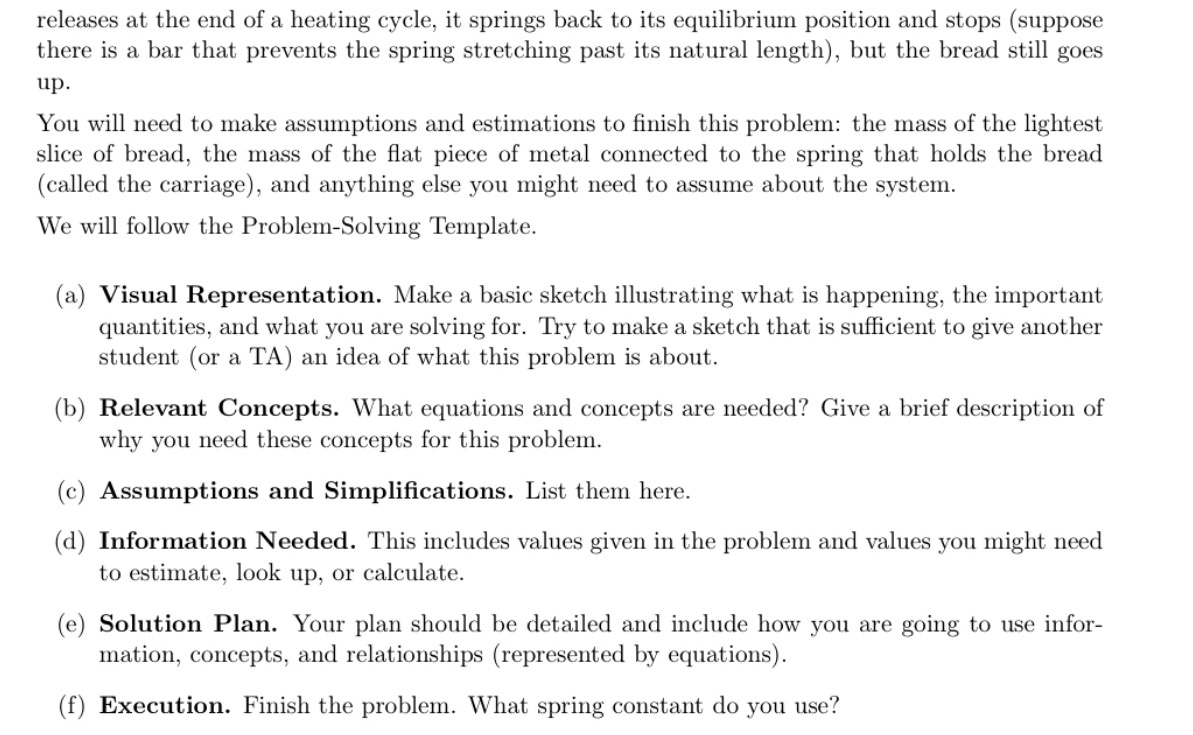
You're designing a toaster, and the last piece it needs is a spring to pop the toast up when it's done. The one requirement from your boss is that the toast never pops out of the toaster, no matter what bread the customer puts in the toaster. In other words, we want to avoid launching the toast out of the toaster. What is the maximum spring constant you can use? The specifications you are given is that the inside of the toaster has 13 cm vertically for the bread when the spring is compressed and 8 cm for the bread when the spring is relaxed. When the spring releases at the end of a heating cycle, it springs back to its equilibrium position and stops (suppose there is a bar that prevents the spring stretching past its natural length), but the bread still goes up. You will need to make assumptions and estimations to finish this problem: the mass of the lightest slice of bread, the mass of the flat piece of metal connected to the spring that holds the bread (called the carriage), and anything else you might need to assume about the system. We will follow the Problem-Solving Template. (a) Visual Representation. Make a basic sketch illustrating what is happening, the important quantities, and what you are solving for. Try to make a sketch that is sufficient to give another student (or a TA) an idea of what this problem is about. (b) Relevant Concepts. What equations and concepts are needed? Give a brief description of why you need these concepts for this problem. (c) Assumptions and Simplifications. List them here. (d) Information Needed. This includes values given in the problem and values you might need to estimate, look up, or calculate. (e) Solution Plan. Your plan should be detailed and include how you are going to use infor- mation, concepts, and relationships (represented by equations). (f) Execution. Complete the problem. What spring constant do you use?
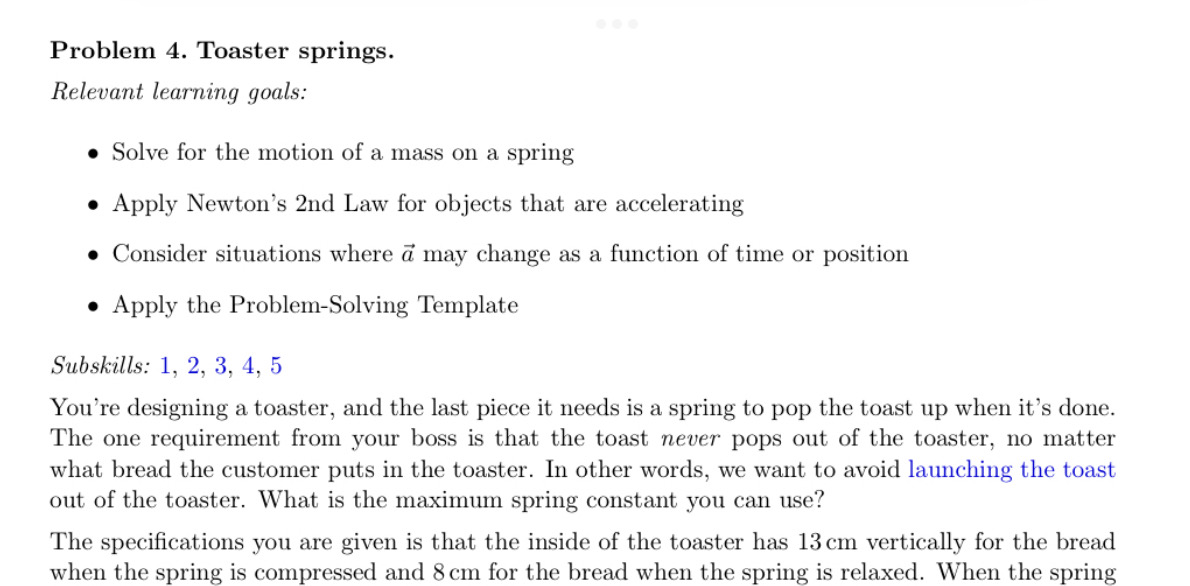
Problem 4. Toaster springs. Relevant learning goals: Solve for the motion of a mass on a spring Apply Newton's 2nd Law for objects that are accelerating Consider situations where a may change as a function of time or position Apply the Problem-Solving Template Subskills: 1, 2, 3, 4, 5 You're designing a toaster, and the last piece it needs is a spring to pop the toast up when it's done. The one requirement from your boss is that the toast never pops out of the toaster, no matter what bread the customer puts in the toaster. In other words, we want to avoid launching the toast out of the toaster. What is the maximum spring constant you can use? The specifications you are given is that the inside of the toaster has 13 cm vertically for the bread when the spring is compressed and 8 cm for the bread when the spring is relaxed. When the spring
Step by Step Solution
There are 3 Steps involved in it

Get step-by-step solutions from verified subject matter experts