







Question: You've Got A Friend Consider a first-order logical language that contains the predicates, A(x), C(x), D(x), to say x is an animal, cat, and dog,
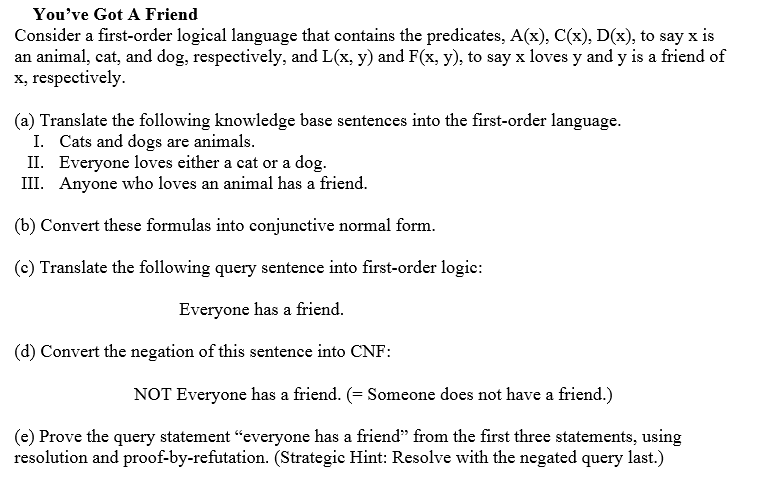
You've Got A Friend Consider a first-order logical language that contains the predicates, A(x), C(x), D(x), to say x is an animal, cat, and dog, respectively, and L(x, y) and F(x, y), to say x loves y and y is a friend of x, respectively. (a) Translate the following knowledge base sentences into the first-order language Cats and dogs are animals II. I. Everyone loves either a cat or a dog Anyone who loves an animal has a friend. III. (b) Convert these formulas into conjunctive normal form (c) Translate the following query sentence into first-order logic Everyone has a friend (d) Convert the negation of this sentence into CNF: NOT Everyone has a friend. (- Someone does not have a friend.) (e) Prove the query statement "everyone has a friend" from the first three statements, using resolution and proof-by-refutation. (Strategic Hint: Resolve with the negated query last.)
Step by Step Solution
There are 3 Steps involved in it

Get step-by-step solutions from verified subject matter experts
 Study Help