







Question: y(t) + y(t) = U. Prove that S is subspace ofCUE). (1)) Let C[1,1] be the vector space of all realvalued functions that are continuous
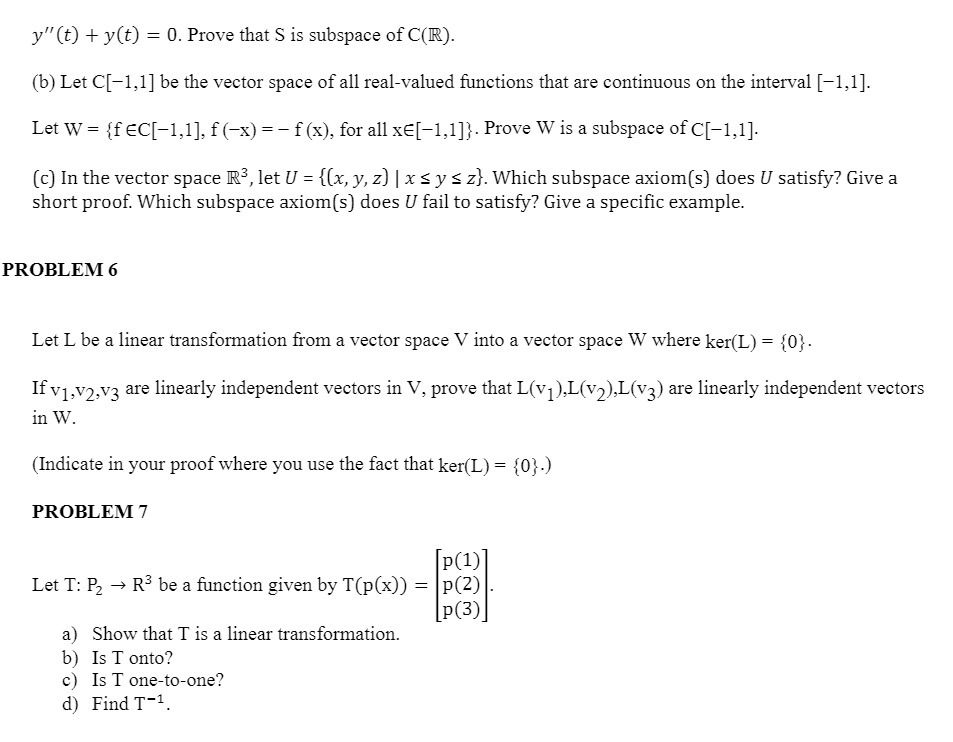
y"(t) + y(t) = U. Prove that S is subspace ofCUE). (1)) Let C[1,1] be the vector space of all realvalued functions that are continuous on the interval [1,1]. Let W = {f EC[1,1], f(x) = for), for all XE[1,1]}. Prove W is a subSpace ofC[1,1]. [c] In the vector space R3, let U = {[x, y, z] | x S y s 2}. Which subspace axiom [s] does U satisfy? Give a short proof. Which subspace axiom[s) does U fail to satisfy? Give a specic example. PROBLEM 6 Let L be a linear transformation from a vector space V into a vector space W where ker(L) = {0}. If \"233 are linearly independent vectors in V, prove that L(v1),L(v2),L(v3} are linearly independent vectors in W. (Indicate in your proof where you use the fact that ker(L) = {0}.) PROBLEM 7 Mil) Let T: P2 > R3 be a lunction given by T(p(x)j 2 p(2) . p8) a) Show that T is a linear transformation. 1)) Is T onto? c) Is T onetoone'? d) Find T'1
Step by Step Solution
There are 3 Steps involved in it

Get step-by-step solutions from verified subject matter experts
 Study Help