



Question: yYou can use the MATLAB Language to do that In exact arithmetic, the partial sums S_N = sigma_k=1^N 1/k diverge as N rightarrow infinity. Write
 yYou can use the MATLAB Language to do that
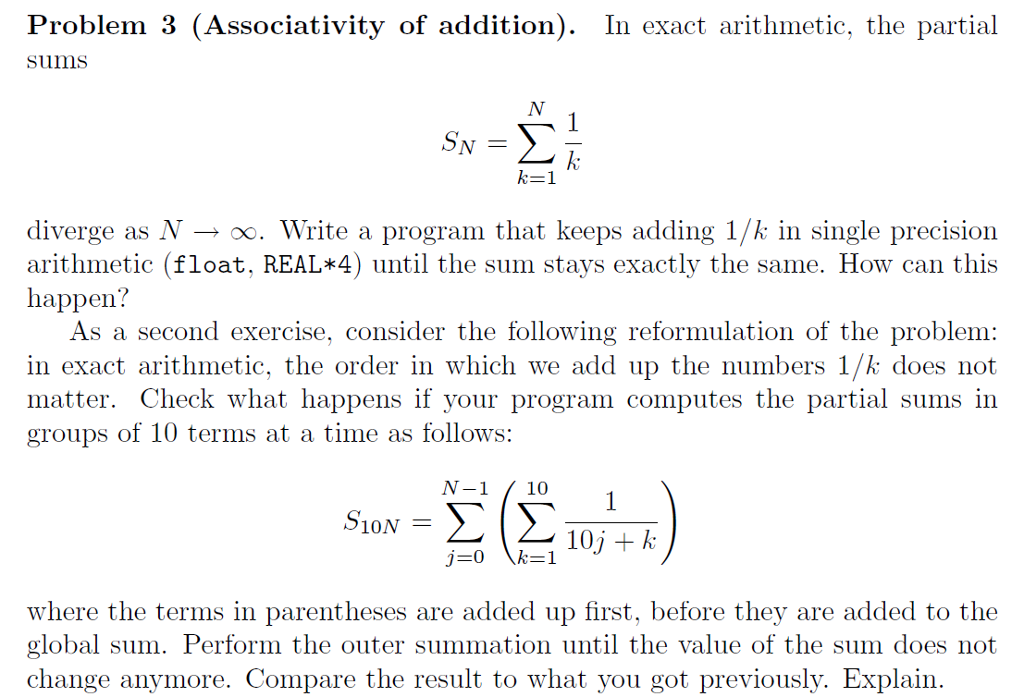
In exact arithmetic, the partial sums S_N = sigma_k=1^N 1/k diverge as N rightarrow infinity. Write a program that keeps adding 1/k in single precision arithmetic (float. REAL*4) until the sum stays exactly the same. How can this happen? As a second exercise, consider the following reformulation of the problem: in exact arithmetic, the order in which we add up the numbers 1/k does not matter. Check what happens if your program computes the partial sums in groups of 10 terms at a time as follows: S_10N = sigma_j=0^n - 1 (sigma_k=1^10 1/10 j + k) where the terms in parentheses are added up first, before they are added to the global sum. Perform the outer summation until the value of the sum does not change anymore. Compare the result to what you got previously. Explain
Step by Step Solution
There are 3 Steps involved in it

Get step-by-step solutions from verified subject matter experts