







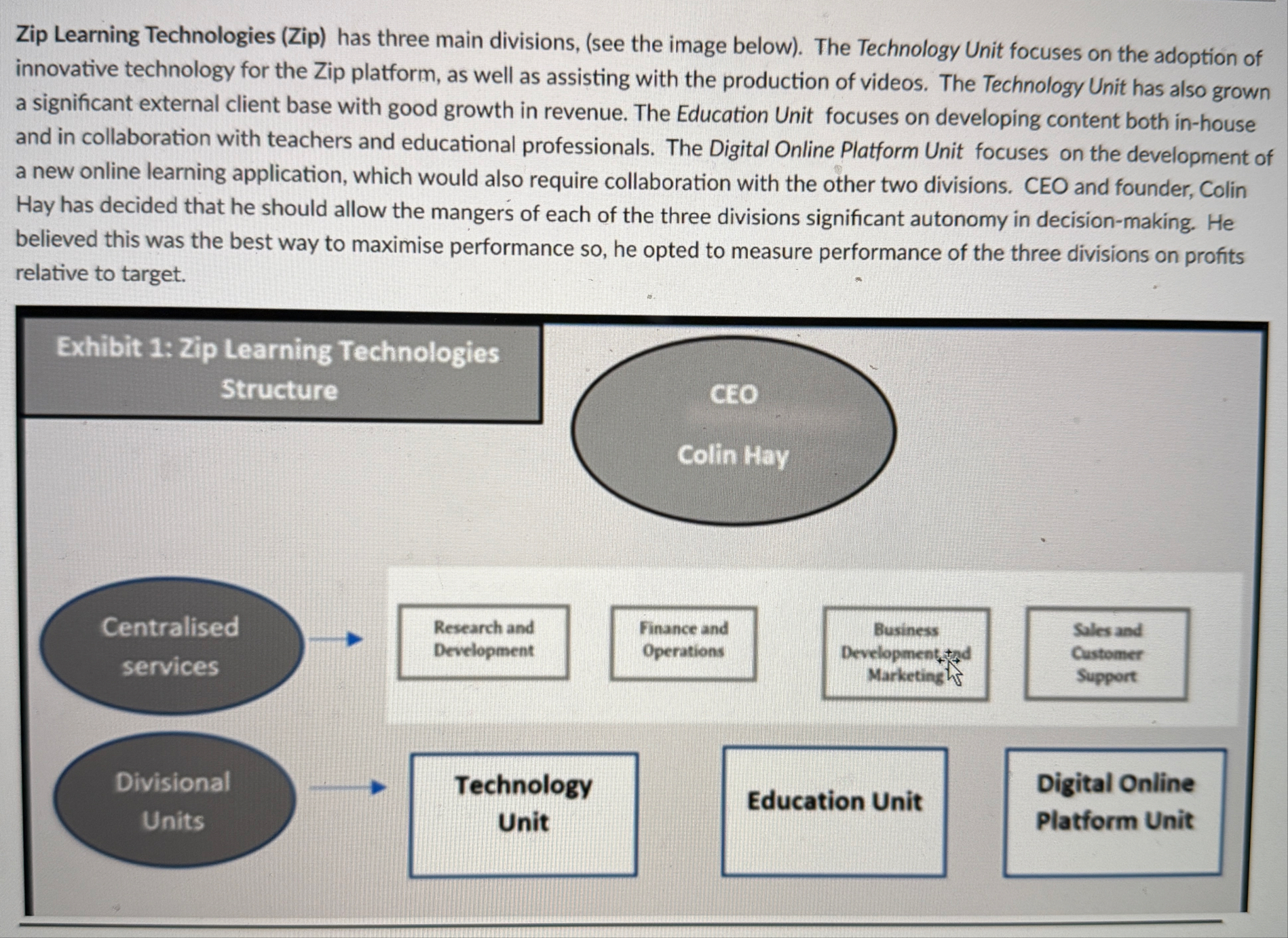
Question: Zip Learning Technologies ( Zip ) has three main divisions, ( see the image below ) . The Technology Unit focuses on the adoption of
Zip Learning Technologies Zip has three main divisions, see the image below The Technology Unit focuses on the adoption of innovative technology for the Zip platform, as well as assisting with the production of videos. The Technology Unit has also grown a significant external client base with good growth in revenue. The Education Unit focuses on developing content both inhouse and in collaboration with teachers and educational professionals. The Digital Online Platform Unit focuses on the development of a new online learning application, which would also require collaboration with the other two divisions. CEO and founder, Colin Hay has decided that he should allow the mangers of each of the three divisions significant autonomy in decisionmaking. He believed this was the best way to maximise performance so he opted to measure performance of the three divisions on profits relative to target.Transfer pricing issues
While Colin valued divisional manager autonomy and decisionmaking, he felt, when it comes to internal transactions, the organisational interests should normally prevail. To this end, the key components of the company's transfer pricing policy were:
all transfers would occur at full cost plus a markup of ;
there would be no sourcing autonomy; transacting internally would be the first priority currently internal transactions account for approximately of divisional activity; and
divisions are permitted to use any spare capacity to meet external demand.
The manager of the Technology unit Carly Taylor has raised concerns about the policy. Carly is proud of the innovation and creativity with the technological developments the division has been able to generate, particularly in the last two years. This has resulted in an increase in demand for their services from external customers. Carly argues that her profits would be higher if she had more autonomy to service outside customers. She says: full costs plus just does not give us enough of a return...we could be earning twice the profit on outside work.....I need more freedom in my decisionmaking....."
Which of the following statements are more likely to be correct:
Note: multiple answers possible
The adoption of a marketbased transfer pricing method combined with sourcing autonomy is more likely to enhance profits at Zip than the use of dualtransfer pricing method with sourcing autonomy
Changing the transfer pricing method will have little effect on managerial motivation as the size of the divisional profits is not relevant to the overall profits of Zip.
The adoption of a dualtransfer pricing policy would work best at Zip to encourage sourcing autonomy and drive profits upwards
The problem with the current transfer pricing policy is that the objective of providing divisional manager autonomy clashes with the reluctance of Colin to embrace sourcing autonomy in intracompany transfer decisions.
Instead of using full cost in the determination of the transfer price, Zip would be better suited to using the variable cost plus a markup of ; as the size of the markup is the critical element.
Step by Step Solution
There are 3 Steps involved in it
1 Expert Approved Answer
Step: 1 Unlock

Question Has Been Solved by an Expert!
Get step-by-step solutions from verified subject matter experts
Step: 2 Unlock
Step: 3 Unlock
 Study Help