







Question: Calculate, using single-fiber collection efficiencies, the overall collection efficiency of a bag filter comprised of glass fibers of mean diameter 10 mm in the form
Calculate, using single-fiber collection efficiencies, the overall collection efficiency of a bag filter comprised of glass fibers of mean diameter 10 mm in the form of a cloth 1-mm thick, taking into account both diffusion (Brownian motion) and impingement. The gas contains 1 g/m3 of dust of specific gravity 2 g/cm3 and has a velocity of 0.1 ft/s. The particle-size distribution is as follows:

Under these conditions, impaction does not occur and reentrainment can be neglected. Figure 19.33 gives the single-layer target collection efficiencies, ht, as a function of gas velocity for diffusion (straight lines) and impingement (curved lines) of dust particles ranging in size from 0.5 to 7 mm for the fiber diameter and dust density of this exercise. If each particle collision results in capture, the overall % efficiency, ho, for each particle size is in terms of the fractional single-layer target efficiency of Figure 19.33, given by
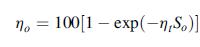
where So is the number of layers or stages of filter. Assume the 1-mm-thick filter cloth has 50 stages.

Dust particle size, m Mass fraction of total dust 3-5 0.45 2-3 0.20 1-2 0.20
Step by Step Solution
3.49 Rating (162 Votes )
There are 3 Steps involved in it
To calculate the overall collection efficiency of a bag filter we need to consider the collection ef... View full answer

Get step-by-step solutions from verified subject matter experts
 Study Help