







Question: In Example 19.10, a laboratory test was conducted with a small, tubular-bowl centrifuge on a fermentation broth. At the operating conditions, a sigma value of
In Example 19.10, a laboratory test was conducted with a small, tubular-bowl centrifuge on a fermentation broth. At the operating conditions, a sigma value of 7,400 ft2 was computed, with a measured volumetric flow rate of 0.11 gpm. For the commercial plant that will process the same broth, the largest tubular bowl centrifuge available has the following characteristics: bowl speed = 15,000 rpm, R0 = 5 cm, R1 = 2 cm, and bowl length = L = 10 cm. Using the sigma scale-up theory, calculate how many gpm this unit can process.
Example 19.10
A laboratory tubular-bowl centrifuge has the following dimensions, with respect to Figure 19.28, and operating conditions: bowl speed 800 rps, R0 = 0.875 inch, R1 = 0.65 in., and bowl length = L = 4.5 inches. When used to remove E. coli cells from the following fermentation broth, a satisfactory volumetric feed capacity of the centrifuge, Q, of 0.11 gpm is achieved.
Broth: ρf = 1.01 g/cm3 and μ = 1.02x10⁻³ kg/m-s
E. coli: smallest diameter = dpmin = 0.7 μm and ρp = 1.04 g/cm3
Assuming the applicability of Stokes’ law, estimate the feed capacity of the centrifuge.
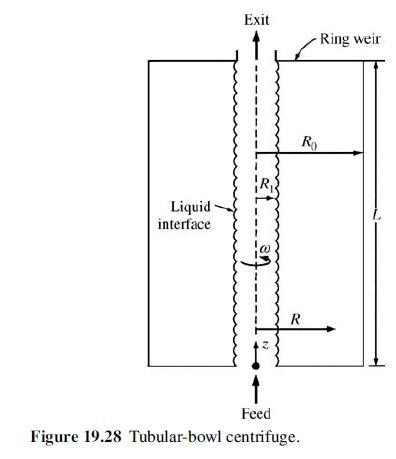
Liquid- interface Exit Ro {R Feed Figure 19.28 Tubular-bowl centrifuge. Ring weir
Step by Step Solution
3.23 Rating (172 Votes )
There are 3 Steps involved in it
Solution 1 First consider the first of these equations 1 RT HS This equ... View full answer

Get step-by-step solutions from verified subject matter experts
 Study Help