







Question: A first-order low-pass analog filter has a transfer function H(s) = 1/(s + 1). (a) If for this filter, the input is x(t) and the
(a) If for this filter, the input is x(t) and the output is y(t) what is the ordinary differential equation representing this filter.
(b) Suppose that we change this filter into a discrete filter using the bilinear transformation
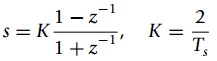
Obtain the transfer function H(z). If for the discrete filter, the input is x[n] and the output y[n] obtain the difference equation representing the discrete filter.
(c) Suppose x(t) = u(t) ˆ’ u(t ˆ’ 0.5) find the output of the analog filter.
(d) Let K = 1000, so that Ts = 2/K is used to sample x(t) to get the discrete signal x[n]. Use the difference equation to solve for the output y[n]. Compare your result with the one obtained by solving the ordinary differential equation for the first three values.
1-z-1 K = -1 T,
Step by Step Solution
3.36 Rating (162 Votes )
There are 3 Steps involved in it
a Differential equation b Replacing s K1 z 1 1 z 1 in Hs we obta... View full answer

Get step-by-step solutions from verified subject matter experts
 Study Help