







Question: A hash function is an algorithm that maps data of variable length to data of a fixed length. Hash functions are used by engineers responsible
A hash function is an algorithm that maps data of variable length to data of a fixed length. Hash functions are used by engineers responsible for data authentication and data encryption on a large scale. In the Journal of Cryptographic Engineering (Nov. 2012), a new algorithm for accelerating hash function computations was proposed. The performance y of the new algorithm (measured as number of CPU cycles per byte), was modeled as a function of message length x (measured in bytes). Data for six different messages submitted for data encryption are listed in the table. Consider the model, E(y) = βo + β1 ln(x).
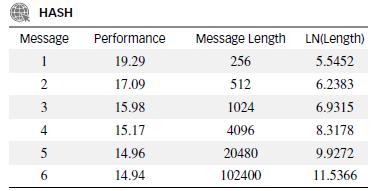
a. Use matrix algebra to find estimates of βo and β1.
b. Conduct the test of overall model adequacy. Use α = .10.
c. Find and interpret a 90% confidence interval for the performance level of the new algorithm when applied to a message of length 5,000 bytes.
HASH Message Performance Message Length LN(Length) 1 19.29 256 5.5452 2 17.09 512 6.2383 3 15.98 1024 6.9315 4 15.17 4096 8.3178 5 14.96 20480 9.9272 6. 14.94 102400 11.5366
Step by Step Solution
3.49 Rating (159 Votes )
There are 3 Steps involved in it
To find the estimates of and using matrix algebra we can set up a linear regression model with the given data Lets denote the performance as y and the natural logarithm of the message length as lnx a ... View full answer

Get step-by-step solutions from verified subject matter experts
 Study Help