







Question: This is a repeated measures analysis with movement in nine people with Multiple Sclerosis at two timepoints (an intervention was given between pre-test and post-test).
This is a repeated measures analysis with movement in nine people with Multiple Sclerosis at two timepoints (an intervention was given between pre-test and post-test). The hypothesis was that movement would be greater after the intervention. Look at the output:
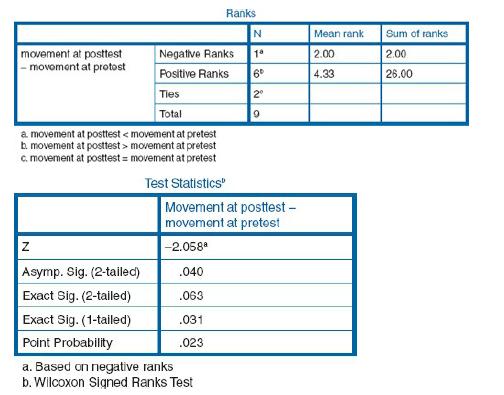
14. Which is the most appropriate conclusion:
a) There were six ranks where post-test movement was greater than pre-test movement
b) There were six ranks where pre-test movement was greater than post-test movement
c) There was one rank where post-test movement was greater than pre-test movement
d) There was one tie
Ranks N Mean rank Sum of ranks movement at posttest Negative Ranks 1 2.00 2.00 -movement at protost Positive Ranks 6 4.33 26.00 Ties 2 Total 9 a. movement at posttest < movement at pretest b. movement at posttest > movement at pretest c. movement at posttest movement at pretest Test Statistics Movement at posttest - movement at protost Z -2.058 Asymp. Sig. (2-tailed) .040 Exact Sig. (2-tailed) .063 Exact Sig. (1-tailed) .031 Point Probability .023 a. Based on negative ranks b. Wilcoxon Signed Ranks Test
Step by Step Solution
There are 3 Steps involved in it

Get step-by-step solutions from verified subject matter experts
 Study Help