



Question: Selected material and energy flows from a bituminous coal-burning power plant are shown in Table 19.7. The ash and flue gas desulfurization (FGD) residue can
Selected material and energy flows from a bituminous coal-burning power plant are shown in Table 19.7. The ash and flue gas desulfurization (FGD) residue can be used to produce cement by replacing sand. The environmental impact per ton of virgin sand includes 0.03 GJ of primary energy use, 2.4 kg CO2eq of greenhouse gas emissions, 0.02 kg of SO2 emissions, and 0.02 ton of NOx emissions. Assuming a 1 : 1 substitution by mass, determine the environmental impact of producing 1 kWh of electricity and 1 kg of Portland cement with and without symbiosis.
Table 19.7:
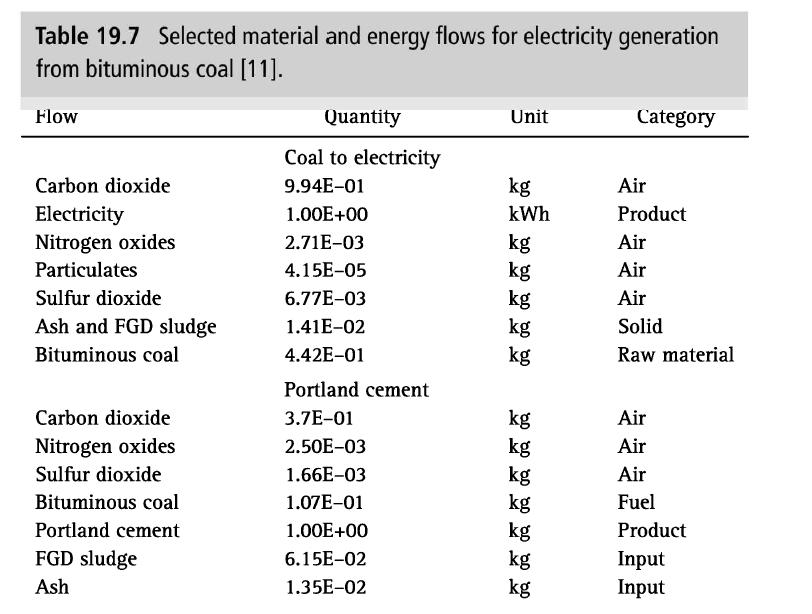
Table 19.7 Selected material and energy flows for electricity generation from bituminous coal [11]. Flow Carbon dioxide Electricity Nitrogen oxides Particulates Sulfur dioxide Ash and FGD sludge Bituminous coal Carbon dioxide Nitrogen oxides Sulfur dioxide Bituminous coal Portland cement FGD sludge Ash Quantity Coal to electricity 9.94E-01 1.00E+00 2.71E-03 4.15E-05 6.77E-03 1.41E-02 4.42E-01 Portland cement 3.7E-01 2.50E-03 1.66E-03 1.07E-01 1.00E+00 6.15E-02 1.35E-02 Unit kg kWh kg kg kg kg kg kg kg kg kg kg kg kg Category Air Product Air Air Air Solid Raw material Air Air Air Fuel Product Input Input
Step by Step Solution
3.34 Rating (151 Votes )
There are 3 Steps involved in it
Environmental impact of producing 1 kWh of electricity and 1 kg of Portland cement without symbiosis 1 kWh of electricity Primary energy use 994E01 GJ... View full answer

Get step-by-step solutions from verified subject matter experts