



Question: Considering Problems 14 and 18, determine the return period associated with the flow capacity that maximizes the expected annual benefit in the channel modification. Data
Considering Problems 14 and 18, determine the return period associated with the flow capacity that maximizes the expected annual benefit in the channel modification.
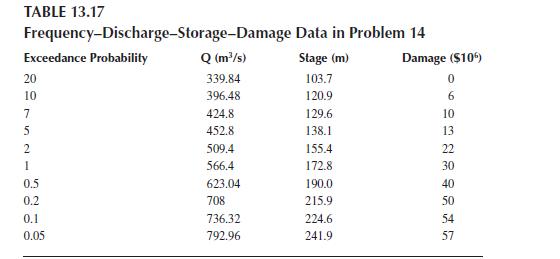
Data from problem 14 The frequency–discharge–storage–damage data for existing conditions at a particular area along a river is given in Table 13. 17. The storage–discharge data make up the rating curve, the discharge–frequency data compose the frequency curve, and the storage–damage data make up the storage–damage curve. Plot these three relationships.
Data from problem 18 Considering Problems 14 and 15, determine the return period for the dike system that maximizes annual expected benefit.
Data from problem 15 If a dike system with a capacity of 15 m3/s were used as one alternative for the situation in Problem 14, develop the damage frequency curve for this alternative.
TABLE 13.17 Frequency-Discharge-Storage-Damage Data in Problem 14 Exceedance Probability 20 10 Q (m/s) Stage (m) Damage ($106) 339.84 103.7 0 396.48 120.9 6 7 5 424.8 129.6 10 452.8 138.1 13 2 509.4 155.4 22 I 566.4 172.8 30 0.5 623.04 190.0 40 0.2 708 215.9 50 0.1 736.32 224.6 54 0.05 792.96 241.9 57
Step by Step Solution
3.49 Rating (152 Votes )
There are 3 Steps involved in it

Get step-by-step solutions from verified subject matter experts