







Question: 424 When using a transistor as a linear amplifier, it is important to avoid driving the transistor into either cutoff or saturation. Since most signals
4–24 When using a transistor as a linear amplifier, it is important to avoid driving the transistor into either cutoff or saturation. Since most signals that are amplified are time varying, the maximum excursions of the time-varying signal should be known. In this problem, the time-varying signal is a 3-V sinusoid, vS = 3 cos ωt V. To avoid driving the transistor into cutoff, a dc bias voltage vBias is added in series with the sinusoid. Your task is to select appropriate values for vBias and RB. Your choices should be the smallest bias voltage necessary to prevent cutoff and a sufficient base resistor to avoid saturation. The parameters of the transistor in Figure P4–24 are β = 90 and Vγ = 0:7 V. After selecting appropriate values for vBias and RB, find the maximum and minimum values of vO for vS = 3 cos ωt V.
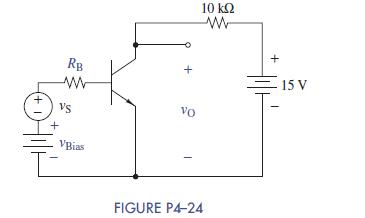
(+ RB ww VS + VBias 10 w Vo FIGURE P4-24 + -15 V
Step by Step Solution
There are 3 Steps involved in it

Get step-by-step solutions from verified subject matter experts
 Study Help