







Question: In Chapter 1, we developed an expression for the Doppler shift associated with a (mathrm{CW}) radar (i.e., (f_{d}= pm v / lambda), where the plus
In Chapter 1, we developed an expression for the Doppler shift associated with a \(\mathrm{CW}\) radar (i.e., \(f_{d}= \pm v / \lambda\), where the plus sign is used for closing targets and the negative sign is used for receding targets). CW radars can use the system shown in the figure below to determine whether the target is closing or receding. Assuming that the emitted signal is \(A \cos \omega_{0} t\) and the received signal is \(k A \cos \left(\left(\omega_{0} \pm \omega_{d}ight) t+\varphiight)\), show that the direction of the target can be determined by checking the phase shift difference in the outputs \(y_{1}(t)\) and \(y_{2}(t)\).
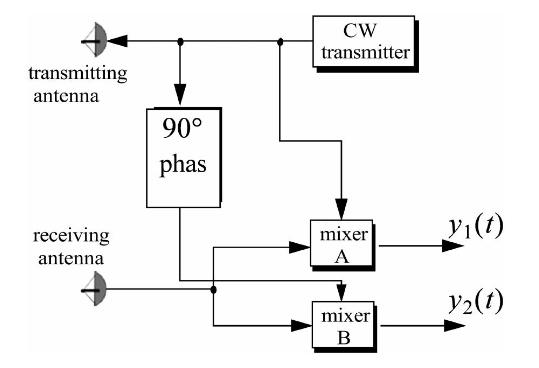
transmitting antenna 90 receiving antenna phas CW transmitter mixer A Yi(t) mixer Y2(t) B
Step by Step Solution
3.38 Rating (148 Votes )
There are 3 Steps involved in it

Get step-by-step solutions from verified subject matter experts
 Study Help