







Question: You are designing capacitors for various applications. For one application, you want the maximum possible stored energy. For another, you want the maximum stored charge.
You are designing capacitors for various applications. For one application, you want the maximum possible stored energy. For another, you want the maximum stored charge. For a third application, you want the capacitor to withstand a large applied voltage without dielectric breakdown. You start with an air-filled parallel-plate capacitor that has C0= 6.00 pF and a plate separation of 2.50 mm. You then consider the use of each of the dielectric materials listed in Table 24.2. In each application, the dielectric will fill the volume between the plates, and the electric field between the plates will be 50% of the dielectric strength given in the table.
(a) For each of the five materials given in the table, calculate the energy stored in the capacitor. Which dielectric allows the maximum stored energy?
(b) For each material, what is the charge Q stored on each plate of the capacitor?
(c) For each material, what is the voltage applied across the capacitor?
(d) Is one dielectric material in the table your best choice for all three applications?
Table 24.2
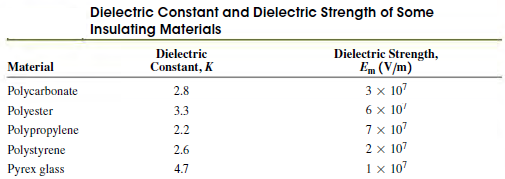
Dielectric Constant and Dielectric Strength of Some Insulating Materials Dielectric Dielectric Strength, E, (V/m) Material Constant, K 2.8 3.3 3 x 10⁷ 6 x 10' 7 x 10⁷ 2 x 10⁷ 1 x 10⁷ Polycarbonate Polyester Polypropylene Polystyrene Pyrex glass 2.2 2.6 4.7
Step by Step Solution
3.39 Rating (165 Votes )
There are 3 Steps involved in it
IDENTIFY and SET UP The presence of the dielectric affects the charge and energy in the capacitor fo... View full answer

Get step-by-step solutions from verified subject matter experts
 Study Help