


Data Driven Modeling And Scientific Computation Methods For Complex Systems And Big Data(1st Edition)
Authors:
Professor Of Applied Mathematics And Electrical And Computer Engineering J Nathan Kutz
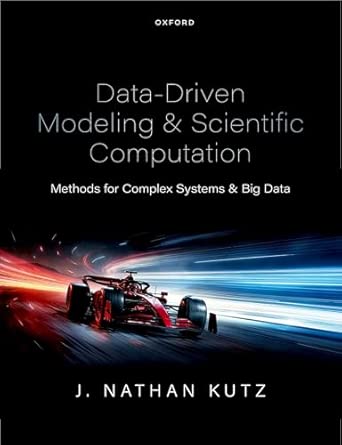
In Stock: 2 Left
Shipment time
Expected shipping within 2 - 3 DaysPopular items with books
Total Price:
$109.61
Solution Manual Includes
Price:
$9.99
Book details
ISBN: 0198929099, 978-0198929093
Book publisher: Oxford University Press

Book Price $109.61 : Data-Driven Modeling & Scientific Computation: Methods For Complex Systems & Big Data Is An Accessible Introductory-to-advanced Textbook Focusing On Integrating Scientific Computing Methods And Algorithms With Modern Data Analysis Techniques, Including Basic Applications Of Machine Learning In The Sciences And Engineering. Its Overarching Goal Is To Develop Techniques That Allow For The Integration Of The Dynamics Of Complex Systems And Big Data. This Comprehensive Textbook Provides A Survey Of Practical Numerical Solution Techniques For Ordinary And Partial Differential Equations As Well As Algorithms For Data Manipulation, Data-driven Modelling, And Machine Learning. Emphasis Is On The Implementation Of Numerical Schemes To Practical Problems In The Engineering, Biological, And Physical Sciences. The High-level Programming Language Python Is Used Throughout The Book To Implement And Develop Mathematical Solution Strategies. One Specific Aim Of The Book Is To Integrate Standard Scientific Computing Methods With The Burgeoning Field Of Data Analysis, Machine Learning And Artificial Intelligence (AI). This Area Of Research Is Expanding At An Incredible Pace In The Sciences Due To The Proliferation Of Data Collection In Almost Every Field Of Science. The Enormous Data Sets Routinely Encountered In The Sciences Now Certainly Give A Big Incentive To Develop Mathematical Techniques And Computational Algorithms That Help Synthesize, Interpret, And Give Meaning To The Data In The Context Of Its Scientific Setting. This Brings Together, In A Self-consistent Fashion, The Key Ideas From (i) Statistics, (ii) Time-frequency Analysis And (iii) Low-dimensional Reductions In Order To Provide Meaningful Insight Into The Data Sets One Is Faced With In Any Scientific Field Today, Including Those Generated From Complex Dynamic Systems. This Is A Tremendously Exciting Area And Much Of This Part Of The Book Is Driven By Intuitive Examples Of How The Three Areas (i)-(iii) Can Be Used In Combination To Give Critical Insight Into The Fundamental Workings Of Various Problems.
Popular Among Students (8)


Programming Embedded Systems With C And GNU Development Tools - 2nd Edition
Michael Barr
ISBN: 0596009836, 978-0596009830
$0 $55.47
High Accuracy Algorithm For The Differential Equations Governing Anomalous Diffusion - 1st Edition
Weihua Deng
ISBN: 9813142200, 9789813142206
$58.17 $83.10

Ghosts Of The Triad Tales From The Haunted Heart Of The Piedmont - 1st Edition
Michael Renegar
ISBN: 1609491408, 978-1609491406
$0 $13.00

Embracing Creation Gods Forgotten Mission - 1st Edition
John Mark Hicks Ph D
ISBN: 0891123369, 978-0891123361
$0 $8.05
Software Measurement Current Trends In Research And Practice - 1st Edition
Reiner Dumke
ISBN: 382446876X, 978-3824468768
$0 $54.99
Design And Analysis Of Hand Written Strings Of Hindi Ann Approach Artificial Neural Network Application - 1st Edition
Anita Venugopal
ISBN: 6204199749, 978-6204199740
$63.7 $91.00Recommended For You (7)

Before We Say Goodbye An Unforgettable Heart Warming Story Of Love And Letting Go Perfect For Fans Of Jojo Moyes - 1st Edition
Madeleine Reiss
ISBN: 1785764195, 978-1785764196
$0 $9.72
Facial Ageing And Injection Anatomy - 1st Edition
Lee Walker
ISBN: 1914195167, 978-1914195167
$111.3 $159.00
Data Driven Modeling And Scientific Computation Methods For Complex Systems And Big Data - 1st Edition
J. Nathan Kutz
ISBN: 0199660344, 978-0199660346
$126.09 $180.13
Picoeconomics The Strategic Interaction Of Successive Motivational States Within The Person - 1st Edition
George Ainslie
ISBN: 0521158702, 978-0521158701
$180.6 $258.00
Numerical Nonsmooth Optimization State Of The Art Algorithms - 1st Edition
Adil M. Bagirov
ISBN: 3030349098, 9783030349097
$106.27 $151.82

Tokenize It Unlocking Value In Real World Assets Exploring The Potential Of Security Tokens And Tokenization - 1st Edition
Barrett Williams
ISBN: B0CY7GR294
$0 $55.21

Ceh Certified Ethical Hacker Bundle Second Edition - 2nd Edition
Matt Walker
ISBN: 0071835571, 978-0071835572
$0 $32.39