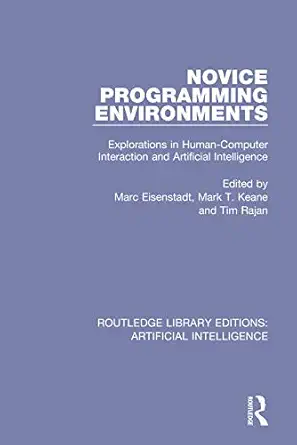
Novice Programming Environments Explorations In Human Computer Interaction And Artificial Intelligence(1st Edition)
Authors:
Marc Eisenstadt ,Mark Keane ,Tim Rajan
In Stock: 1 Left
Shipment time
Expected shipping within 2 - 3 DaysPopular items with books
Total Price:
$119
Solution Manual Includes
Price:
$9.99
Book details
ISBN: 0815351623, 978-0815351627
Book publisher: Routledge

Book Price $119 : This Book, Originally Published In 1992, Encapsulates Ten Years Of Research At The Open Universityâ??s Human Cognition Research Laboratory. The Research Investigates The Problems Of Novice Programmers, And Is Strongly Oriented Toward The Design And Implementation Of "programming Environments" Aimed At Eliminating Or Easing Novicesâ?? Problems. A Range Of Languages Is Studied: Pascal, SOLO, Lisp, Prolog And "Knowledge Engineering Programming". The Primary Emphasis Of The Empirical Studies Is To Gain Some Understanding Of Novicesâ?? "mental Models" Of The Inner Workings Of Computers. Such (erroneous) Models Are Constructed By Novices In Their Own Heads To Account For The Idiosyncrasies Of Particular Programming Languages. The Primary Emphasis Of The Implementations Described In The Book Is The Provision Of "automatic Debugging Aids", I.e. Artificial Intelligence Programs Which Can Analyse Novicesâ?? Buggy Programs, And Make Sense Of Them, Thereby Providing Useful Advice For The Novices. Another Related Strand Taken In Some Of The Work Is The Concept Of "pre-emptive Design", I.e. The Provision Of Tools Such As Syntax-directed Editors And Graphical Tracers Which Help Programmers Avoid Many Frequently-occurring Errors. A Common Thread Throughout The Book Is Its Cognitive Science/Artificial Intelligence Orientation. AI Tools Are Used, For Instance, To Construct Simulation Models Of Subjects Writing Programs, In Order To Provide Insights Into What Their Deep Conceptual Errors Are. At The Other Extreme, AI Programs Which Were Developed In Order To Help Student Debug Their Programs Are Observed Empirically In Order To Ensure That They Provide Facilities Actually Needed By Real Programmers. This Book Will Be Of Great Interest To Advanced Undergraduate, Postgraduate, And Professional Researchers In Cognitive Science, Artificial Intelligence, And Human-Computer Interaction.
Popular Among Students (8)


Mindful Money Management Memoirs Of A Hedge Fund Manager - 1st Edition
Joel Salomon
ISBN: 0999280406, 978-0999280409
$0 $14.49

Knowledge Science Engineering And Management 10th International Conference Ksem 2017 Melbourne Vic Australia August 19 20 2017 Proceedings - 1st Edition
Gang Li
ISBN: 3319635573, 978-3319635576
$0 $41.99

Journals Of Patrick Gass The Member Of The Lewis And Clark - 1st Edition
Carol Lynn Macgregor
ISBN: 0878423516, 978-0878423514
$0 $56.03
Internet Of Energy For Smart Cities - 1st Edition
Anish Jindal
ISBN: 036749955X,1000411001
$73.47 $104.95

Computer Operating Systems - 1st Edition
Wu Qi Yuan / Liang Yan
ISBN: 7302067791, 978-7302067795
$0 $57.00
Domine Microsoft Windows Server 2003 - 1st Edition
Laura Raya Gonzalez
ISBN: 8478977503, 978-8478977505
$0 $38.00
Pain Suffering And Resilience Orthodox Christian Perspectives - 1st Edition
Phd Stephen Muse
ISBN: 1936773481, 978-1936773480
$0 $14.50Recommended For You (6)


Apple Pie Promises A Swirl Novel - 1st Edition
Hillary Homzie
ISBN: 1510739238, 978-1510739239
$0 $25.57

YouTube Secrets The Ultimate Guide To Growing Your Following And Making Money As A Video Influencer - 1st Edition
Sean Cannell
ISBN: 1544511817, 978-1544511818
$0 $14.95

Last Days Survival Guide A Scriptural Handbook To Prepare You For These Perilous Times - 1st Edition
Rick Renner
ISBN: 1680314106, 978-1680314106
$0 $19.99
Towards The Internet Of Services The Theseus Research Program - 1st Edition
Wolfgang Wahlster
ISBN: 3319361279, 978-3319361277
$0 $54.99