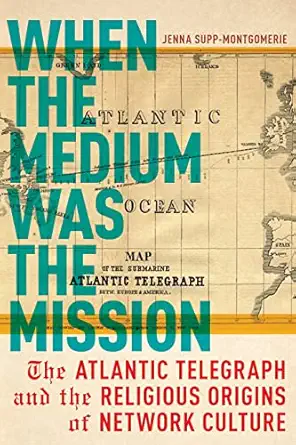
When The Medium Was The Mission The Atlantic Telegraph And The Religious Origins Of Network Culture(1st Edition)
Authors:
Jenna Supp Montgomerie
In Stock: 1 Left
Shipment time
Expected shipping within 2 - 3 DaysPopular items with books
Total Price:
$72.8
Solution Manual Includes
Price:
$9.99
Book details
ISBN: 1479801496, 978-1479801497
Book publisher: NYU Press
Book Price $72.8 : **FINALIST, 2022 PROSE Award In Theology & Religious Studies**An Innovative Exploration Of Religion's Influence On Communication NetworksWhen Samuel Morse Sent The Words â??what Hath God Wroughtâ? From The US Supreme Court To Baltimore In Mere Minutes, It Was The First Public Demonstration Of Words Travelling Faster Than Human Beings And Farther Than A Line Of Sight In The US. This Strange Confluence Of Media, Religion, Technology, And US Nationhood Lies At The Foundation Of Global Networks.The Advent Of A Telegraph Cable Crossing The Atlantic Ocean Was Viewed Much The Way The Internet Is Today, To Herald A Coming World-wide Unification. President Buchanan Declared That The Atlantic Telegraph Would Be â??an Instrument Destined By Divine Providence To Diffuse Religion, Civilization, Liberty, And Law Throughout The Worldâ? Through Which â??the Nations Of Christendom [would] Spontaneously Unite.â? Evangelical Protestantism Embraced The New Technology As Indicating Godâ??s Support For Their Work To Christianize The Globe. Public Figures In The US Imagined This New Communication Technology In Primarily Religious Terms As Offering The Means To Unite The World And Inspire Peaceful Relations Among Nations. Religious Utopianists Saw The Telegraph As The Dawn Of A Perfect Future.Religious Framing Thus Dominated The Interpretation Of The Technologyâ??s Possibilities, Forging An Imaginary Of Networks As Connective, So Much So That Connection Is Now Fundamental To The Idea Of Networks. In Reality, However, Networks Are Marked, At Core, By Disconnection. With Lively Historical Sources And An Accessible Engagement With Critical Theory, When The Medium Was The Mission Tells The Story Of How Connection Was Made Into The Fundamental Promise Of Networks, Illuminating The Power Of Public Protestantism In The First Network Imaginaries, Which Continue To Resonate Today In False Expectations Of Connection.
Popular Among Students


Separation Of Molecules Macromolecules And Particles Principles Phenomena And Processes - 1st Edition
Kamalesh K. Sirkar
ISBN: 0521895731, 9780521895736
$0 $76.89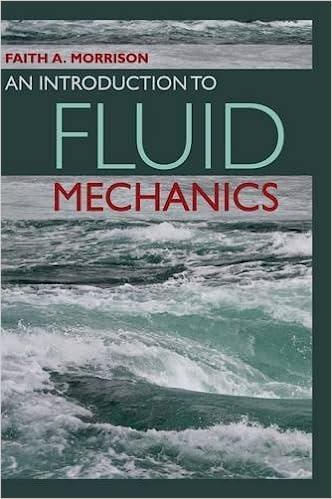
An Introduction To Fluid Mechanics - 1st Edition
Faith A. Morrison
ISBN: 1107003539, 9781107003538
$84.08 $120.11
Chemical Engineering An Introduction - 1st Edition
Morton Denn
ISBN: 1107011892, 9781107011892
$125.3 $179.00
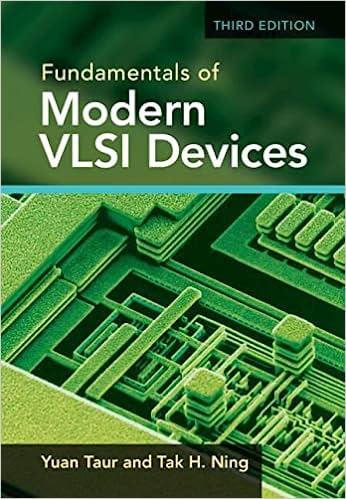
Fundamentals Of Modern VLSI Devices - 3rd Edition
Yuan Taur
ISBN: 1108480020, 9781108480024
$0 $51.99
Project Financing Asset-Based Financial Engineering - 3rd Edition
John D Finnerty
ISBN: 1118421841, 9781118421840
$0 $63.00

Searching For The Lost Tombs Of Egypt - 1st Edition
Chris Naunton
ISBN: 0500295441, 978-0500295441
$0 $34.60

Devils Bargains Tourism In The Twentieth Century American West - 1st Edition
Hal K Rothman
ISBN: 0700610561, 978-0700610563
$0 $34.58

Best Tent Camping Arizona Your Car Camping Guide To Scenic Beauty The Sounds Of Nature And An Escape From Civilization - 1st Edition
Kirstin Olmon Phillips
ISBN: 1634040767, 978-1634040761
$0 $33.58

A War Of Frontier And Empire The Philippine American War 1899 1902 - 1st Edition
David J Silbey
ISBN: 0809096617, 978-0809096619
$0 $11.68
Islam And Christianity Today A Contribution To Dialogue - 1st Edition
W M Watt
ISBN: 0415446708, 978-0415446709
$165.9 $237.00