







Question: The function ?(x) displayed in Eq. 38-19 describes a free particle, for which we assumed that U(x) = 0 in Schrodinger's equation (Eq. 38-15). Assume
The function ?(x) displayed in Eq. 38-19 describes a free particle, for which we assumed that U(x) = 0 in Schrodinger's equation (Eq. 38-15). Assume now that U(x) = U0 = a constant in that equation. Show that Eq. 38-19 is still a solution of Schr6dinger's equation, with now giving the angular wave number k of the particle.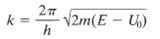
V2m(E U)
Step by Step Solution
★★★★★
3.52 Rating (166 Votes )
There are 3 Steps involved in it
1 Expert Approved Answer
Step: 1 Unlock

For U Uo Schrdingers equation becomes ... View full answer
Question Has Been Solved by an Expert!
Get step-by-step solutions from verified subject matter experts
Step: 2 Unlock
Step: 3 Unlock
Document Format (1 attachment)

18-P-M-P-P-M-W (61).docx
120 KBs Word File
 Study Help