



Question: There are two types of consumers 1 and 2 with demands: P 1 (Q) = a b 1 Q P 2 (Q) = a
There are two types of consumers 1 and 2 with demands:
P1(Q) = a – b1Q
P2(Q) = a – b2Q
The monopolist has a marginal cost function given by
MC(Q)
a. Shows that if there is no price discrimination, then the profit maximizing price and quantity, (P*, Q*), satisfy
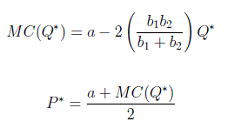
b. Under third degree price discrimination, let (P1, Q1) and (P2, Q2) be the profit maximizing prices and quantities for consumers 1 and 2, respectively. Show that:
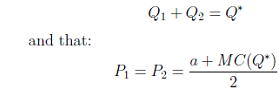
That is, under this particular kind of demand system a monopolist that can practice third degree price discrimination will not benefit from doing so. It will choose prices that are the same for both customers and equal to the price level under no price discrimination.
bib2 2(5+ b3) MC(Q') = a 2 Q* b + b2 a + MC(Q*) 2 P*:
Step by Step Solution
3.44 Rating (170 Votes )
There are 3 Steps involved in it
a Without PD P 1 P 2 P Total Q a Pb 1 aPb 2 P a b 1 b 2 b 1 b ... View full answer

Get step-by-step solutions from verified subject matter experts
Document Format (1 attachment)

68-B-F-F-M (2256).docx
120 KBs Word File