







Question: To simulate materials processing under the microgravity conditions of space, a niobium sphere of diameter 3 mm is levitated by an acoustical technique in a
To simulate materials processing under the microgravity conditions of space, a niobium sphere of diameter 3 mm is levitated by an acoustical technique in a vacuum chamber. Initially the sphere is at 300 K and is suddenly irradiated with a laser providing an irradiation of 10 W/mm 2 to raise its temperature as quickly as possible to its melting point (2741 K). When the melting point is reached, the laser is switched off and a radio frequency (RF) heater is energized, causing uniform internal volumetric generation q to occur within the sphere. Assume that the niobium sphere is isothermal and diffuse and gray with an emissivity of 0.6, and that the chamber walls are at 300 K.
(a) How much time is required to reach the melting point?
(b) How much power must be provided by the RF heater to maintain the sphere at its melting point?
(c) Is the space wise isothermal assumption realistic for the conditions of parts (a) and (b)?
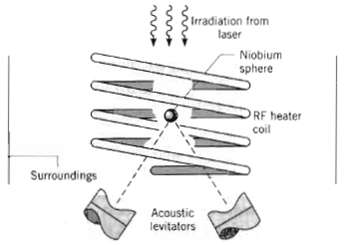
Irradiation from laser Niobium sphere RF heater coil Surroundings Acoustic levitators
Step by Step Solution
3.52 Rating (169 Votes )
There are 3 Steps involved in it
KNOWN Niobium sphere levitated in surroundings at 300 K and initially at 300 K is suddenly irradiated with a laser 10 Wm and heated to its melting tem... View full answer

Get step-by-step solutions from verified subject matter experts
Document Format (1 attachment)

8-E-M-E-H-M-T (1180).docx
120 KBs Word File
 Study Help