







Question: Two engineers are having an argument about the efficiency of a tube-side multipass heat exchanger compared to a similar exchanger with a single tube-side pass.
Two engineers are having an argument about the efficiency of a tube-side multipass heat exchanger compared to a similar exchanger with a single tube-side pass. Mr. Smith claims that for a given number of tubes are rate of heat transfer, more area is required in a two-pass exchanger than in a one-pass, because the effective temperature difference is less. Mr. Jones, on the other hand, claims that because the tube-side velocity and hence coefficient is higher, less area is required in a two-pass exchanger. With the conditions given below, which is correct? Which case would you recommend, of what changes in the exchanger would you recommend?
Exchanger specifications
– 200 tube passes total
– 1 inch O.D copper tubes, 16 B.W.G.
Tube-side fluid
Water entering at 16°C, leaving at 28°C, with a rate of 225,000 kg/h
Shell-side fluid
Mobiltherm 600, entering at 50°C, leaving at 33°C.
Shell side coefficient = 1700 W/(m2 K)
GIVEN
- Tube and shell heat exchanger - water in tubes, Mobiltherm 600 in shell
- Number of tube passes (Np) = 200
- Tubes are 1 in copper 16 B.W.G.
- Water flow rate (mw) = 225,000 kg/h = 62.5 kg/s
- Water temperatures
- Tw,in = 16°C
- Tw,out = 28°
- Mobiltherm temperatures
- Tm,in = 50°C
- Tm,out = 33°C
- Shell side heat transfer coefficient (ho) = 1700 W/(m2 K)
ASSUMPTIONS
- Thermal resistance of copper tube wall is negligible
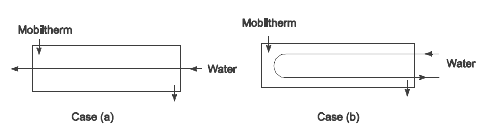
Moblitherm Mobiltherm Water + Water Case (a) Case (b)
Step by Step Solution
3.31 Rating (175 Votes )
There are 3 Steps involved in it
For case a number of flow passages N Total passespasses per tube 2001 200 For case b N ... View full answer

Get step-by-step solutions from verified subject matter experts
Document Format (1 attachment)

66-E-M-E-H-M-T (1865).docx
120 KBs Word File
 Study Help