







Question: A fractionating column equipped with a partial reboiler heated with steam, as shown in Figure 7.40, and with a total condenser, is operated continuously to
A fractionating column equipped with a partial reboiler heated with steam, as shown in Figure 7.40, and with a total condenser, is operated continuously to separate a mixture of 50 mol% A and 50 mol% B into an overhead product containing 90 mol% A and a bottoms product containing 20 mol% A. The column has three theoretical plates, and the reboiler is equivalent to one theoretical plate. When the system is operated at an LV = 0.75 with the feed as a saturated liquid to the bottom plate of the column, the desired products can be obtained. The system is instrumented as shown. The steam to the reboiler is controlled by a flow controller so that it remains constant. The reflux to the column is also on a flow controller so that the quantity of reflux is constant. The feed to the column is normally 100 kmol/h, but it was inadvertently cut back to 25 kmol/h. What would be the composition of the reflux and what would be the composition of the vapor leaving the reboiler under these new conditions? Assume that the vapor leaving the reboiler is not superheated. Relative volatility for the system is 3.0.
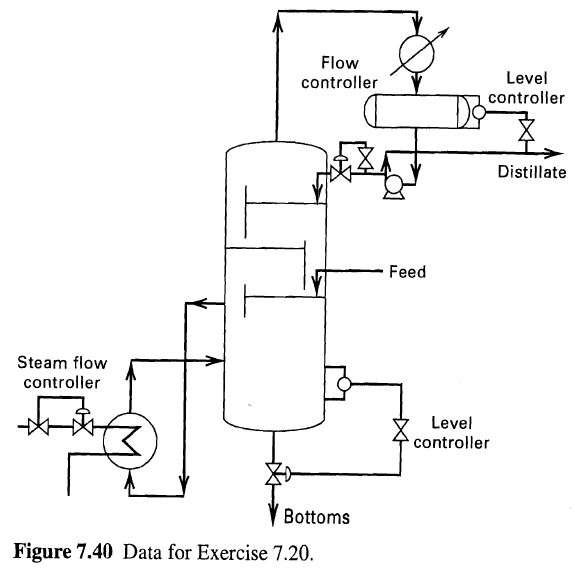
Flow Level controller controller Distillate Feed Steam flow controller Level controller Bottoms Figure 7.40 Data for Exercise 7.20.
Step by Step Solution
3.51 Rating (171 Votes )
There are 3 Steps involved in it
First verify the separation for a feed rate of 100 kmolh This is shown in the McCabeThiele plot belo... View full answer

Get step-by-step solutions from verified subject matter experts
Document Format (1 attachment)

37-E-C-E-S-P (264).docx
120 KBs Word File
 Study Help