



Question: A platinum hot-wire anemometer operated in the constant-temperature mode has been used to measure the velocity of a helium stream. The wire diameter is 20
A platinum hot-wire anemometer operated in the constant-temperature mode has been used to measure the velocity of a helium stream. The wire diameter is 20 m, its length is 5 mm, and it is operated at 90°C. The electronic circuit used to maintain the wire temperature has a maximum power output of 5 watts and is unable to accurately control the wire temperature if the voltage applied to the wire is less than 0.5 volt. Compare the operation of the wire in the helium stream at 20°C and 10 m/s with operation in air and water at the same temperature and velocity. The electrical resistance of the platinum at 90°C is 21.6W-cm.
GIVEN
- A constant temperature platinum hot-wire in a stream of helium
- Wire diameter = 20 m = 20 x 10–6 m
- Wire length (L) = 5 mm = 0.005 m
- Wire temperature (Tw) = 90°C
- Maximum electric power to wire (Pmax) = 5 W
- Minimum voltage (Vmin) = 0.5 V
- Helium temperature (T∞) = 20°C
- Helium velocity (U∞) = 10 m/s
- Resistivity (re) = 21.6 W cm = 21.6 x 10⁻⁸ W m
ASSUMPTIONS
- Radiation is negligible
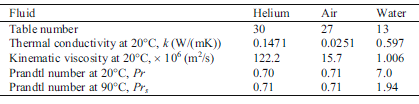
Air 27 Fluid Table number Helium 30 Water 13 0.597 1.006 Thermal conducti vity at 20C, k (W/(mK) 0.1471 122.2 0.0251 Kinematic viscosity at 20C, x 10 (m2/s) 15.7 Prandtl number at 20C, Pr 0.70 0.71 7.0 Prandtl number at 90C, Pr, 0.71 0.71 1.94
Step by Step Solution
3.36 Rating (165 Votes )
There are 3 Steps involved in it
The Nusselt number is given by Equation 73 and Table 71 H... View full answer

Get step-by-step solutions from verified subject matter experts
Document Format (1 attachment)

66-E-M-E-H-M-T (1804).docx
120 KBs Word File