







Question: A shell-and-tube heat exchanger with one shell pass and two tube passes is used as a regenerator, to preheat milk before it is pasteurized. Cold
A shell-and-tube heat exchanger with one shell pass and two tube passes is used as a regenerator, to preheat milk before it is pasteurized. Cold milk enters the regenerator at Tc,i = 5?C, while hot milk, which has completed the pasteurization process, enters at Th,i = 70?C. After leaving the regenerator, the heated milk enters a second heat exchanger, which raises its temperature from Tc,o to 70?C.
(a) A regenerator is to be used in a pasteurization process for which the flow rate of the milk is mc = mh = 5 kg/s. For this flow rate, the manufacturer of the regenerator specifies an overall heat transfer coefficient of 2000 W/m2 ? K. If the desired effectiveness of the regenerator is 0.5, what is the requisite heat transfer area? What are the corresponding rate of heat recovery and the fluid outlet temperatures? Milk may be assumed to have the properties of water.
(b) If the hot fluid in the secondary heat exchanger derives its energy from the combustion of natural gas and the burner has an efficiency of 90%, what would be the annual savings in energy and fuel costs associated with installation of the regenerator? The facility operates continuously through-out the year, and the cost of natural gas is Cvg = $0.0075/MJ.
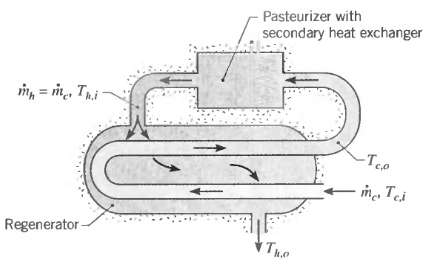
Pasteurizer with secondary heat exchanger m, = rit,. Thi TcP Regenerator- The
Step by Step Solution
3.45 Rating (171 Votes )
There are 3 Steps involved in it
KNOWN Flow rate inlet temperatures and overall heat transfer coefficient for a regenerator Desired r... View full answer

Get step-by-step solutions from verified subject matter experts
Document Format (1 attachment)

8-E-M-E-H-M-T (1024).docx
120 KBs Word File
 Study Help