







Question: A study was done on children, aged 6 months to 18 years, who had nonlethal scorpion stings. Each child was randomly assigned to receive an
A study was done on children, aged 6 months to 18 years, who had nonlethal scorpion stings. Each child was randomly assigned to receive an experimental antivenom or a placebo. "Good" results were no symptoms after four hours and no detectable plasma venom.
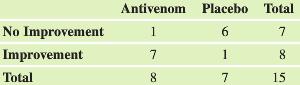
The alternative hypothesis is that the antivenom leads to improvement. The p-value for a one-tailed Fisher's Exact Test with these data is 0.009.
a. Suppose the study had turned out differently, as in the following table.
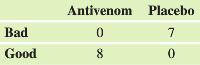
Would Fisher's Exact Test have led to a p-value larger or smaller than 0.009? Explain.
b. Suppose the study had turned out differently, as in the following table.
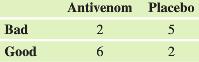
Would Fisher's Exact Test have led to a p-value larger or smaller than 0.009? Explain.
c. Try the two tests, and report the p-values. Were you right? Search for a Fisher's Exact Test calculator on the Internet, and use it.
Antivenom Placebo Total No Improvement Improvement Total 15 Antivenom Placebo Bad Good 0 Antivenom Placebo Bad Good
Step by Step Solution
3.45 Rating (165 Votes )
There are 3 Steps involved in it
a You would get a smaller pvalue because it is more ... View full answer

Get step-by-step solutions from verified subject matter experts
Document Format (1 attachment)

484-M-S-N-S (751).docx
120 KBs Word File
 Study Help